


.avif)





.svg)
.svg)



Should Modular Scale be used in 2025?

Modular Scale has established itself as a discreet but essential pillar for establishing coherent visual hierarchies in the design world. It's the ideal tool for structuring your typography and spacing, guaranteeing effortless visual harmony. But in 2025, with the constant emergence of new tools and changing practices, does this seemingly simple instrument retain its relevance for your creations? Simplicity, relevance of ratios, potential limits... After years of using it at Easy Web, here I share my feedback and objective opinion on its real usefulness for your needs.
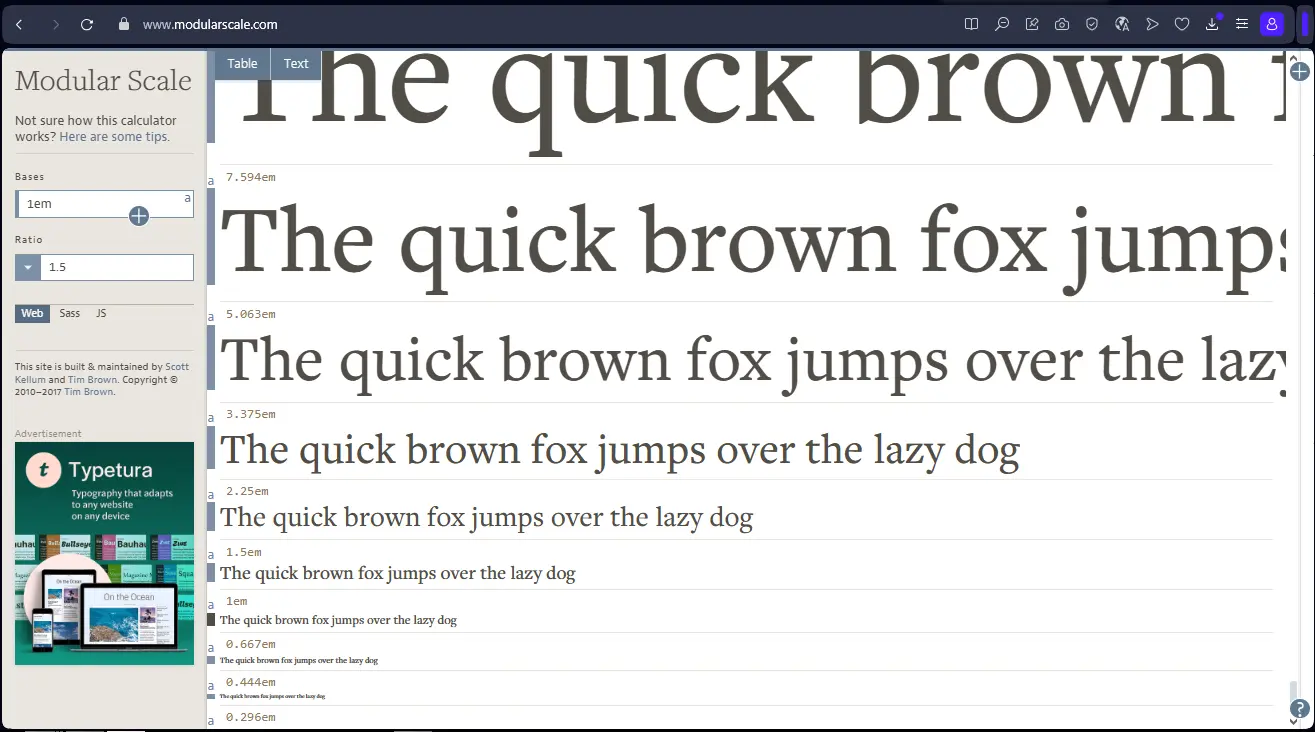
My experience with Modular Scale
Modular Scale has been a fixture in my toolkit for years. Since the first mock-ups at Easy Web, it's been a mainstay for creating consistent typography. What I love about it is its ability to generate impeccable visual harmony for every project.
Why is it so valuable? For us designers and agencies, typography is the backbone of UI/UX. Modular Scale automates the creation of harmonious ratios for text and spacing, greatly simplifying the workflow. The result: consistency that makes a difference.
However, let's be honest. While Modular Scale is excellent for laying the foundations, it doesn't do everything. It provides the science of scales, but the artistic touch, the choice of fonts, and the precise adaptation to the content, that's our role as designers. It's a tool, not a replacement.
Is Modular Scale really useful for my needs?
The real question to ask yourself before using Modular Scale is: what is my objective? Because the relevance of Modular Scale depends very much on how you use it. If your goal is to build a solid, coherent typographic hierarchy, where each text element aligns naturally, it's a formidable tool for defining proportional font sizes.
Whether you're a solo web designer, a UI/UX designer or an agency, Modular Scale saves you precious time by guaranteeing impeccable visual consistency. To define your H1, H2, body text or captions, it offers you an indisputable mathematical and aesthetic basis, optimizing your daily workflow.
Its other major asset is its ability to offer you effortless experimentation. You can quickly test different ratios and bases to find the perfect harmony, a real decision-making aid that smoothes your creative process.


Is Modular Scale suitable for beginners?
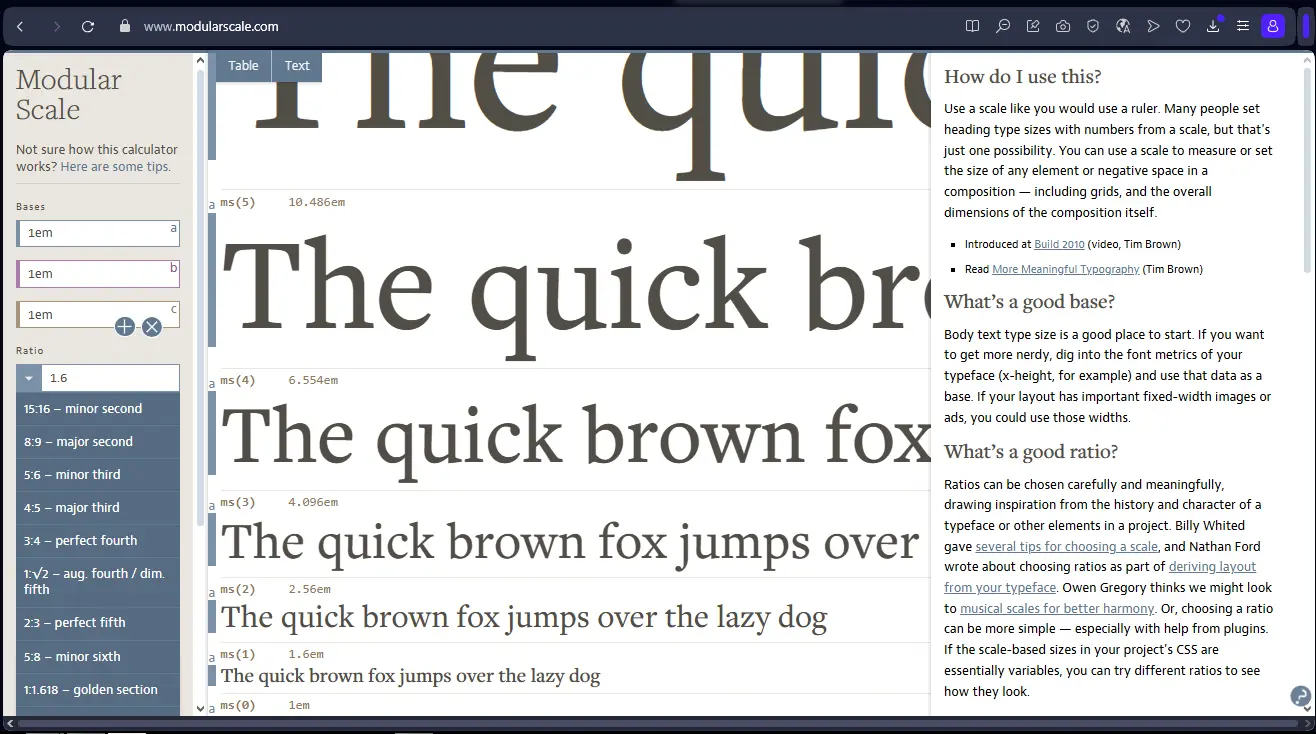
You're just starting out in design and typography seems like a mountain? Modular Scale is the ideal co-pilot. It radically simplifies the creation of harmonious typographic hierarchies. No more font size headaches: you choose a base, a ratio, and the tool generates a whole coherent scale. Remember to use it to define your headings, paragraphs, but also your margins or paddings, ensuring perfect proportionality.
It's an invaluable aid for laying solid foundations without drowning in complex mathematical theory. The tool guides you visually, allowing you to develop your eye for rhythm and balance without even consciously thinking about it. For me, it's one of the best ways to demystify the principles of composition and quickly gain confidence in your projects.
How much does Modular Scale cost?
Let's talk money. You know, what often makes the difference when choosing a tool is its cost. For Modular Scale, it's pretty simple: there are no direct pay-as-you-go packages.
The main and most widespread "formula" is free access. You'll find Modular Scale in the form of open-source web calculators or embeddable CSS and JS libraries. This no-cost version offers you the essentials: the ability to generate harmonious scales for your typography and spacing, guaranteeing impeccable visual consistency. It's the perfect tool for freelance designers, small teams and even large agencies that already integrate these principles. The cost is zero, but the investment in time saved and improved design quality is considerable. If costs do exist, they are generally linked to larger platforms that integrate this functionality.
What are Modular Scale's key features?
Modular Scale is all about the art of harmonious typography. Gone are the headaches of arbitrary font sizes! This tool generates a coherent, visually balanced scale based on mathematical or musical ratios. It automatically creates a clear hierarchy, from H1 to body text. For us, it's the guarantee of a professional design that exudes cleanliness, without hours of fumbling.
What makes Modular Scale powerful for us is its flexibility. Far from simple presets, you define the base size and choose precise ratios (Perfect Fourth, Golden Ratio...). This customization is essential. It allows you to adapt the typographic scale to each brand identity, ensuring perfect visual consistency. It's precise control that makes all the difference for a bespoke, professional design.
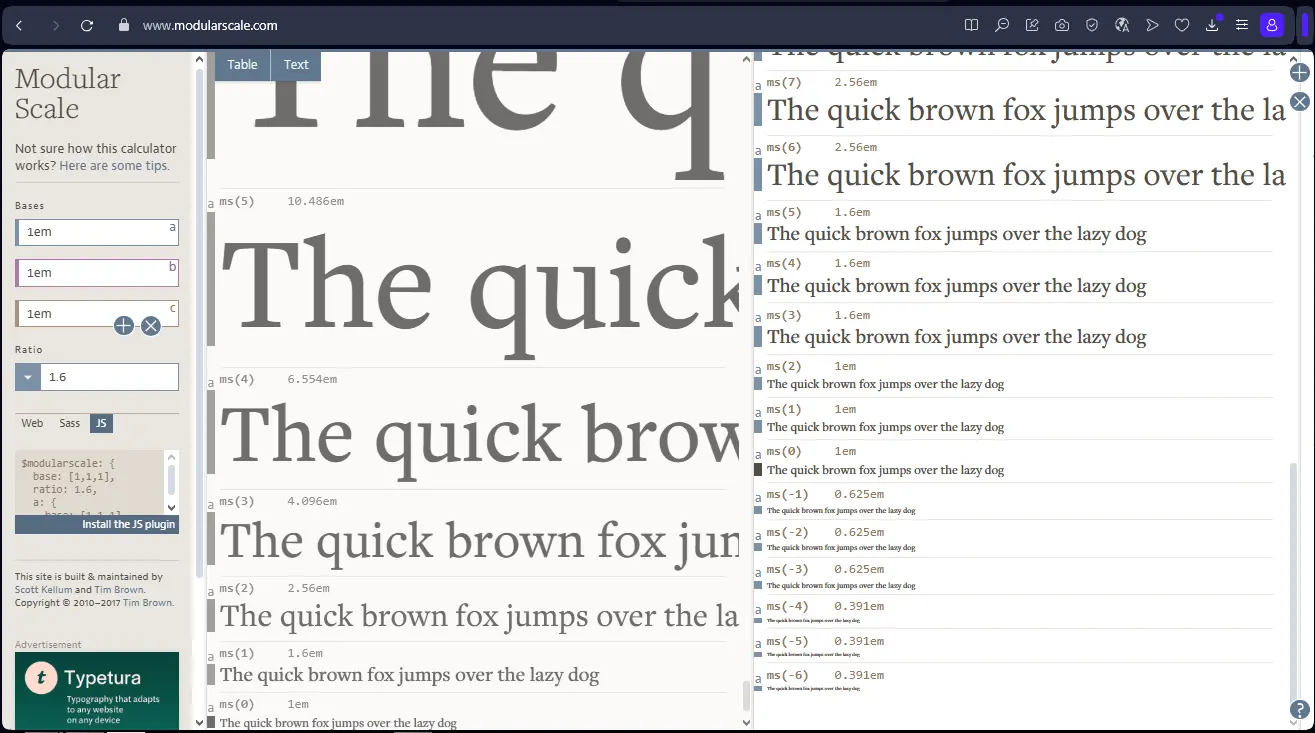
What makes Modular Scale truly powerful is its ability to handle complex ratios. We're not just talking about classic scales; you can define your own custom ratios, or even compound scales. This is ideal for creating a truly unique typographic identity, far removed from standards, and guaranteeing precise visual harmony across all your designs. At Easy Web, this flexibility is a major asset for our most demanding customer projects.
Another strong point: flexibility with base values and dynamic incrementation. You can define multiple starting points for your scale, which is crucial for responsive design. Imagine adjusting a base size and instantly seeing how all text sizes adapt, maintaining the proportion. This greatly simplifies the adaptation of your typography on different screens, ensuring consistency and legibility everywhere.
Modular Scale is great for typography, but its limitations quickly become apparent. For complex spacing or responsive grids where proportions vary drastically, it can lack flexibility. I've seen teams struggle to apply it to component paddings or section margins that don't strictly follow the textual scale, making it less relevant.
For these cases, tools like Figma (with Auto Layout) or design token systems offering greater flexibility are better suited. Modular Scale, on the other hand, remains unbeatable when it comes to building a coherent and powerful typographic hierarchy. It excels where it's designed to shine, and that's what you need to remember.
Clearly:
Benefits: Strong typographic consistency, natural visual hierarchy, simplified text size choices.
Disadvantages: Less suited to complex spacing and dynamic grids, limited flexibility outside the typographic framework.
FAQS
Is it reliable and secure?
Its reliability, when it comes to the online tool or its code implementations, is intrinsic to its mathematical nature. It's not a complex application with databases or user accounts. It's a calculation. Security, in this context, mainly concerns the website on which you're using an online generator. For my part, at Easy Web, we integrate it directly via Sass or CSS variables, which eliminates any external concerns. The concept itself is intrinsically reliable.
Is it compatible with my other tools?
Clearly, Modular Scale integrates more as a methodology or a design principle than as stand-alone software. Its strength lies precisely in its flexibility. You often implement it via variables in your CSS preprocessors like Sass or Less, or via dedicated JavaScript libraries. This makes it compatible with virtually any web development environment - whether you're on React, Vue.js, or CMS. It's less a question of "plug-and-play compatibility" than of adopting its principles within your design system and codebase.
Is there responsive customer support?
When you use a tool like Modular Scale, you have to understand that support isn't that of a classic SaaS. There's no dedicated customer service with tickets or guaranteed SLAs (Service Level Agreements). It's an open source project, so you're relying above all on an active community and solid documentation. If I've ever needed help, it's always via specialized forums or GitHub that I've found my answers. It's a more collaborative model, where autonomy is king.
What do other users think?
Global feedback has been excellent. Designers praise Modular Scale for its ability to create impeccable visual consistency, especially on typography and spacing. They appreciate the automation it brings, reducing the time spent manually adjusting sizes and margins. This is often cited as a major time-saver and a means of ensuring harmonious aesthetics. For many, it has become a must-have for robust design systems.
Can I easily change later?
Global feedback has been excellent. Designers praise Modular Scale for its ability to create impeccable visual consistency, especially on typography and spacing. They appreciate the automation it brings, reducing the time spent manually adjusting sizes and margins. This is often cited as a major time-saver and a means of ensuring harmonious aesthetics. For many, it has become a must-have for robust design systems.
Alternatives
.svg)

Specializing in business creation, sales and digital marketing, he puts his expertise at the service of users to help them identify the solutions best suited to their needs. Passionate about digital innovation and optimizing online performance, Alexis is committed to providing detailed, transparent and unbiased comparisons.
Do you have an entrepreneurial project?
We support you in the structuring and development of your tech project. Make an appointment with one of our Business Strategists.