


.avif)





.svg)



Should Parabola be used in 2025?

Parabola is positioned as a powerful solution for web developers and agencies wishing to automate data handling and processing without exhaustive coding. By combining an intuitive visual interface with advanced automation capabilities, this tool makes it possible to create complex workflows to manage data from multiple sources. But in a constantly evolving environment, can Parabola really meet the demanding needs of professionals?
This article takes an in-depth look at Parabola's functions, its usefulness in different professional contexts and its potential limitations. Together, we'll discover whether this tool deserves a place in your technical arsenal in 2025.
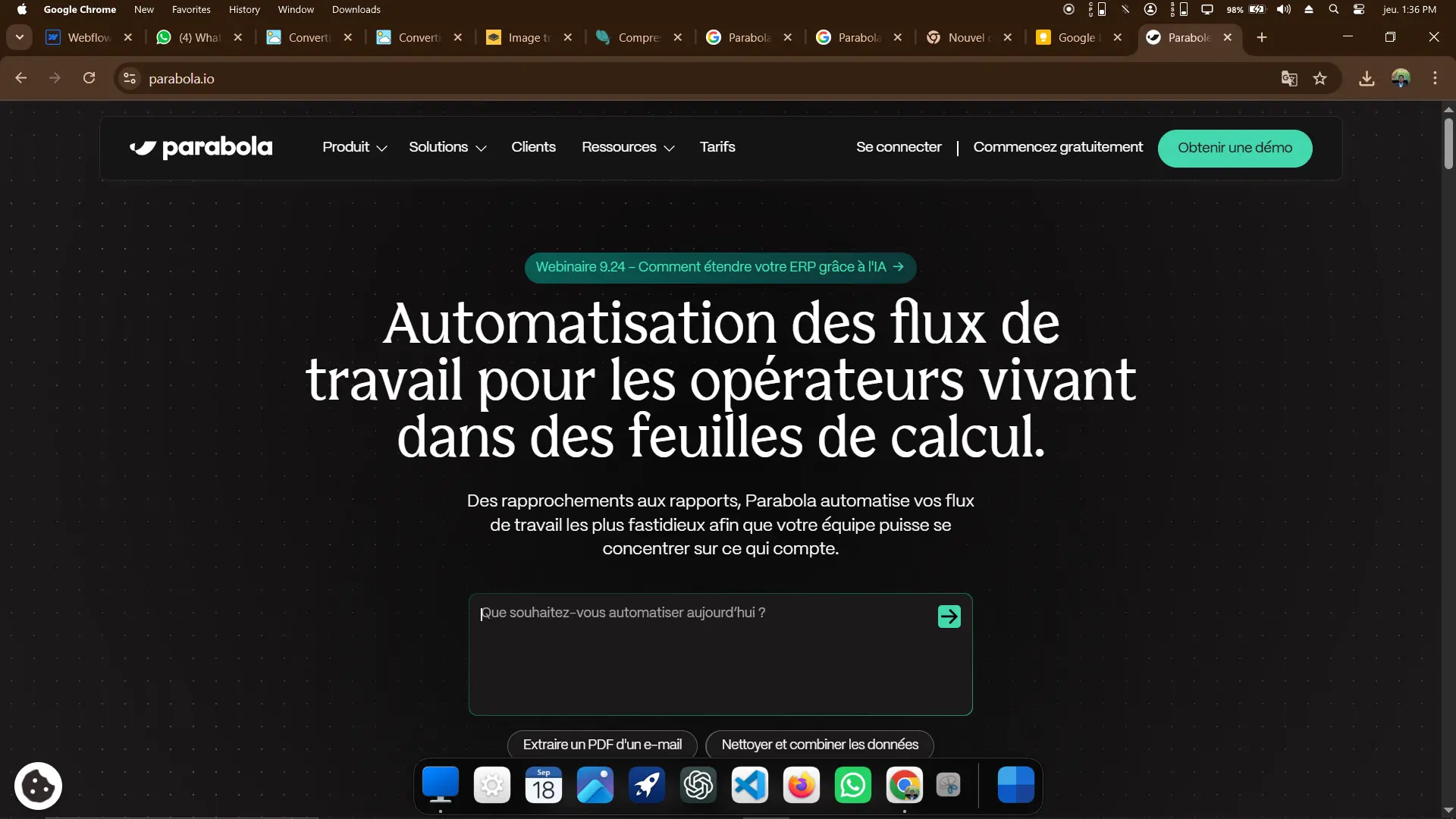
My experience with Parabola
In a professional context, I've used Parabola mainly to automate repetitive data processing, notably in the manipulation of CSV files and the integration of various APIs. A particular strength was its ability to easily orchestrate complex processes via its drag-and-drop interface, without the need for heavy code writing. This ease of use considerably accelerated my projects while minimizing human error.
Parabola particularly excels in contexts where data comes from disparate sources and requires cleansing or transformation before exploitation. Its flexibility in connecting different platforms (Google Sheets, Airtable, Shopify, etc.) makes it a valuable ally for agile teams.
However, the tool shows certain limitations as soon as workflows become highly specialized or require deep customizations in code. What's more, its cost can rapidly increase depending on data volumes and execution frequency, requiring fine-tuned analysis before adoption.
Is Parabola really useful for my needs?
The real question to ask yourself before adopting Parabola is: how complex and how much data do I need to process on a regular basis? Parabola offers a nice combination of visual simplicity and functional power, but its usefulness largely depends on these criteria.
Among the typical personas who could benefit from Parabola are:
- Developers who want to automate without developing overly complex scripts.
- Web agencies managing multiple customer data integrations.
- Marketing managers wishing to automate report consolidation without resorting to heavy BI.
Another Parabola strength is its ability to integrate naturally into a technological ecosystem via its connectors and APIs, facilitating gradual, scalable adoption.

Is Parabola suitable for beginners?
Parabola is positioned overall as an accessible tool for beginners with an appetite for data manipulation, thanks to its drag-and-drop design and pre-built templates.
For a novice, it also offers an environment for learning the concepts of automation and workflow management in a visual way, which can be a good springboard before switching to more technical solutions. Integrated support and documentation resources complete this support.
How much does Parabola cost?
Parabola offers a free entry-level package that lets you test basic functionality with a limited quota of monthly tasks, ideal for small projects or getting started.
The main paid package starts at €39/month and offers expanded access to functions, higher processing quotas and the ability to manage multiple workflows in parallel. This offer is primarily aimed at medium-sized teams and agencies wishing to automate several regular data flows.
For companies with very high volume or frequency requirements, customized packages are available, enabling quotas and functionality to be tailored to their needs. These tailor-made offers require direct contact with the sales department.
What are Parabola's key features?
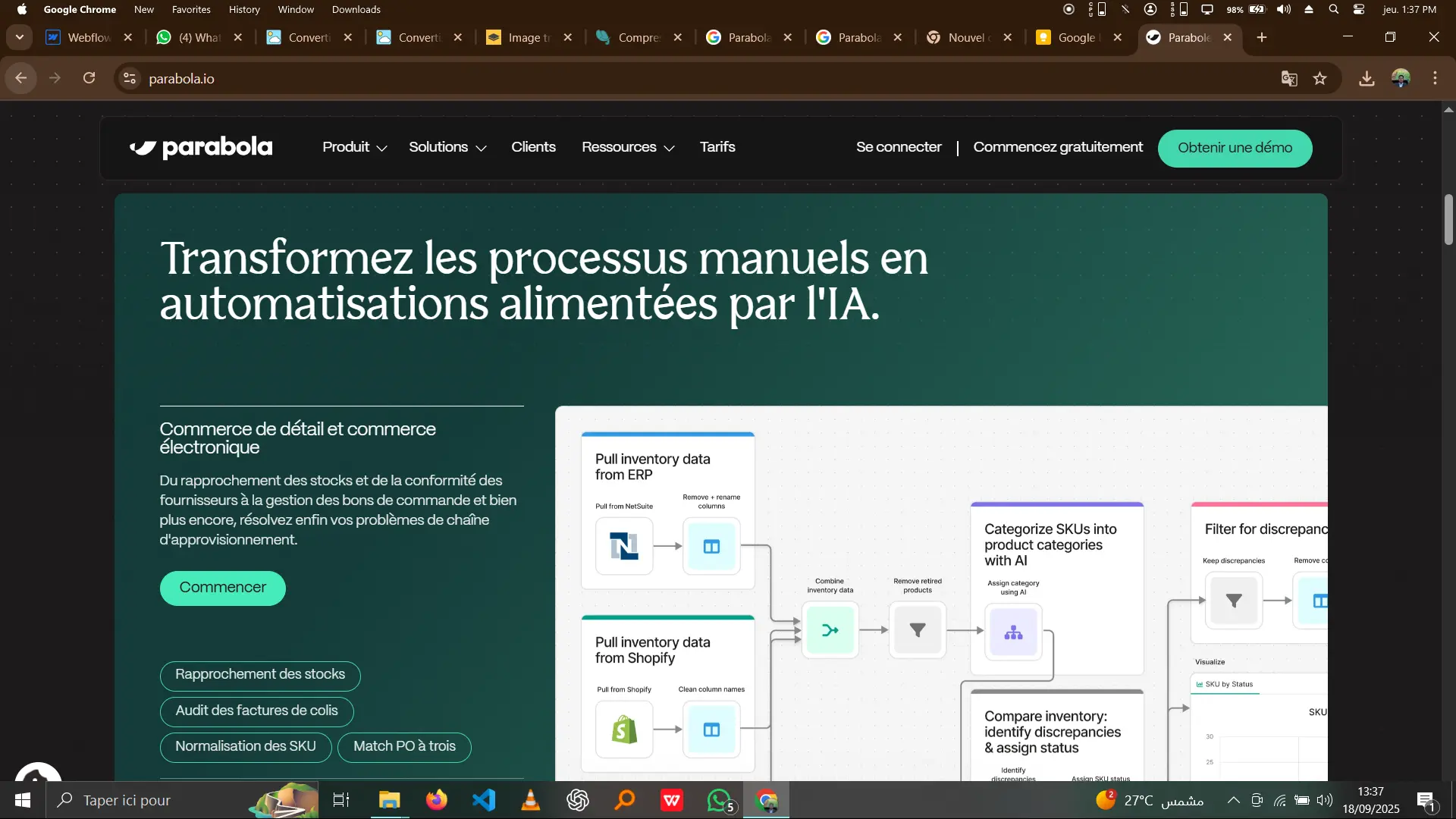
Parabola's number one key feature is its visual workflow creation interface. It makes it easy to arrange data collection, transformation, and integration steps without code, making automation accessible to non-developers and speeding up processes for professionals.
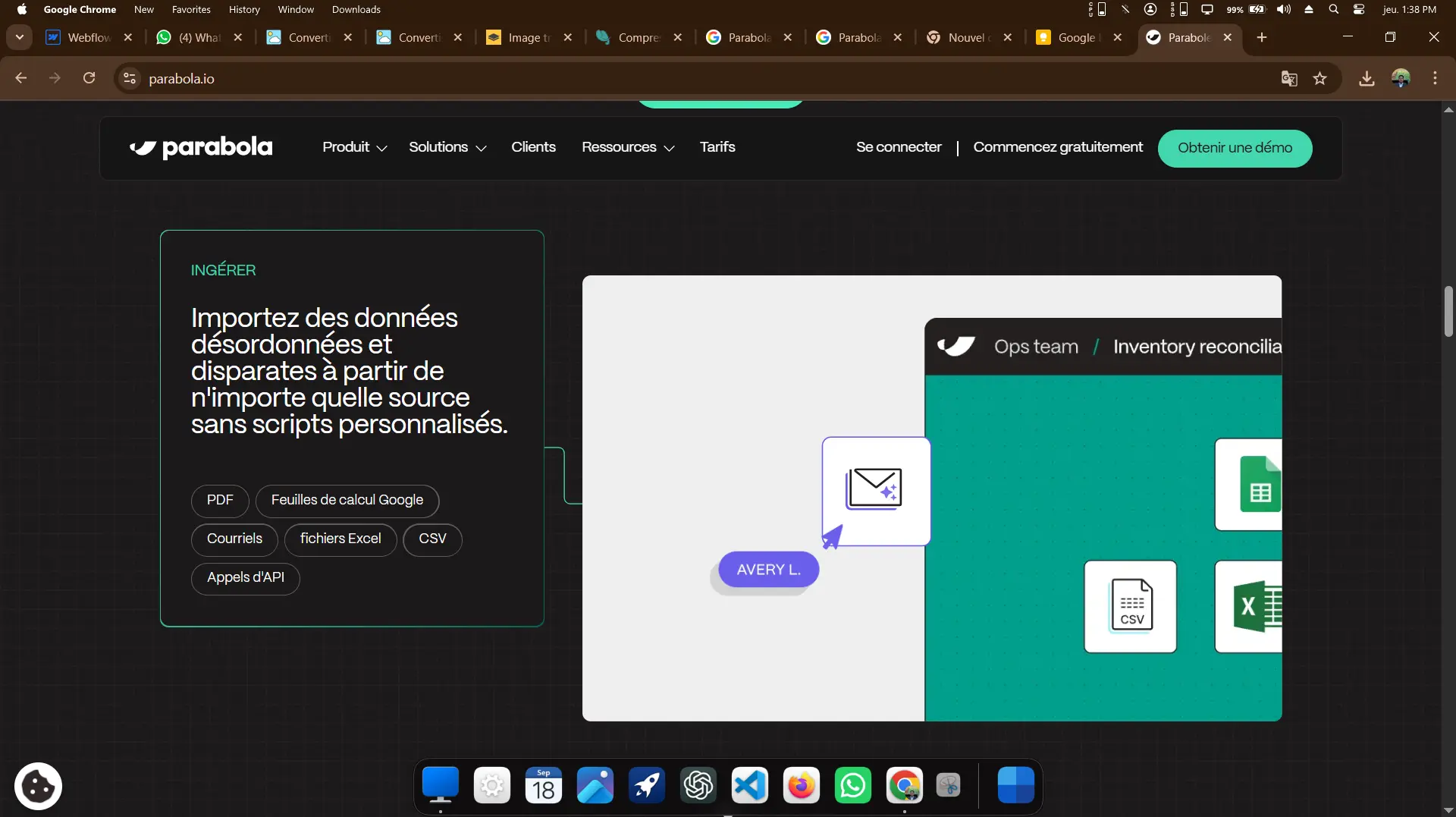
Another major feature is its wide range of native connectors (Google Sheets, Airtable, Shopify, CSV, external APIs) that facilitate the centralization and exchange of data between disparate systems, a real asset for agencies and developers working on multi-source projects.
Among the advanced features, Parabola allows the use of custom functions via JavaScript scripts, offering increased flexibility when standard options are not enough.
The tool also integrates workflow scheduling capabilities to automate tasks at regular intervals, optimizing team time and ensuring the freshness of processed data without manual intervention.
Parabola shows its limitations mainly in highly technical use cases requiring advanced, non-standardized processing, such as machine learning or high-performance modeling. For these needs, dedicated tools remain more appropriate.
Facing Parabola, competitors such as Zapier or Integromat (Make) offer alternatives that are often more flexible in terms of pure automation, while BI solutions such as Tableau or Power BI are preferable for in-depth analysis.
The advantages of Parabola lie in its relative simplicity and power, but this also comes with certain constraints: less customizable code than classic frameworks, costs to be monitored according to usage, and a learning curve to master its abstract logic well.
FAQS
Is it reliable and secure?
Parabola relies on robust security standards, including encryption of data in transit via TLS and at rest on their servers. What's more, the platform complies with GDPR standards, guaranteeing compliant management of personal data.
The cloud infrastructures used benefit from regular backups and redundancies to ensure the tool's availability and resilience. As a result, Parabola proves reliable for critical data flows, provided that user access and permissions are properly configured.
Is it compatible with my other tools?
Parabola is compatible with numerous standard formats such as CSV, JSON and Excel, facilitating data import/export. What's more, its open APIs allow custom integrations with other third-party systems, greatly increasing its scope.
Native connectors to popular applications enable quick and easy synchronization, ideal for workflows integrated into an existing technology ecosystem.
Is there responsive customer support?
Parabola's customer support is characterized by average responsiveness, with turnaround times generally under 24 hours on weekdays. The team offers comprehensive documentation and video tutorials to support users.
Tickets can be submitted via the official website, and an online chat is accessible for paying subscribers, guaranteeing support tailored to the needs of professionals.
What do other users think?
Parabola's user reviews highlight its ease of use and its ability to automate complex processes without heavy programming. This simplicity will particularly appeal to hybrid profiles, between technical and management.
However, some users note a sometimes high cost for very high-volume uses and regret limited customization beyond the functions offered, reflecting a targeted rather than generalist positioning.
Can I easily change later?
Parabola's user reviews highlight its ease of use and its ability to automate complex processes without heavy programming. This simplicity will particularly appeal to hybrid profiles, between technical and management.
However, some users note a sometimes high cost for very high-volume uses and regret limited customization beyond the functions offered, reflecting a targeted rather than generalist positioning.
Alternatives
.svg)

Specializing in business creation, sales and digital marketing, he puts his expertise at the service of users to help them identify the solutions best suited to their needs. Passionate about digital innovation and optimizing online performance, Alexis is committed to providing detailed, transparent and unbiased comparisons.
Do you have an entrepreneurial project?
We support you in the structuring and development of your tech project. Make an appointment with one of our Business Strategists.