


.avif)





.svg)



Should Houdini be used in 2025?

.svg)
Houdini is a must-have reference in the world of advanced motion design and visual effects (VFX), prized by production studios and demanding professionals alike. Known for its exceptional power and flexibility, this tool is primarily aimed at 3D artists, editors and content creators who need to create complex simulations and sophisticated procedural animations. But can Houdini really meet all modern production needs, or is it reserved for a very specific niche?
In this article, we'll explore Houdini's key features, benefits, limitations, as well as its pricing positioning, to help you determine whether this tool is right for you in 2025.
My experience with Houdini
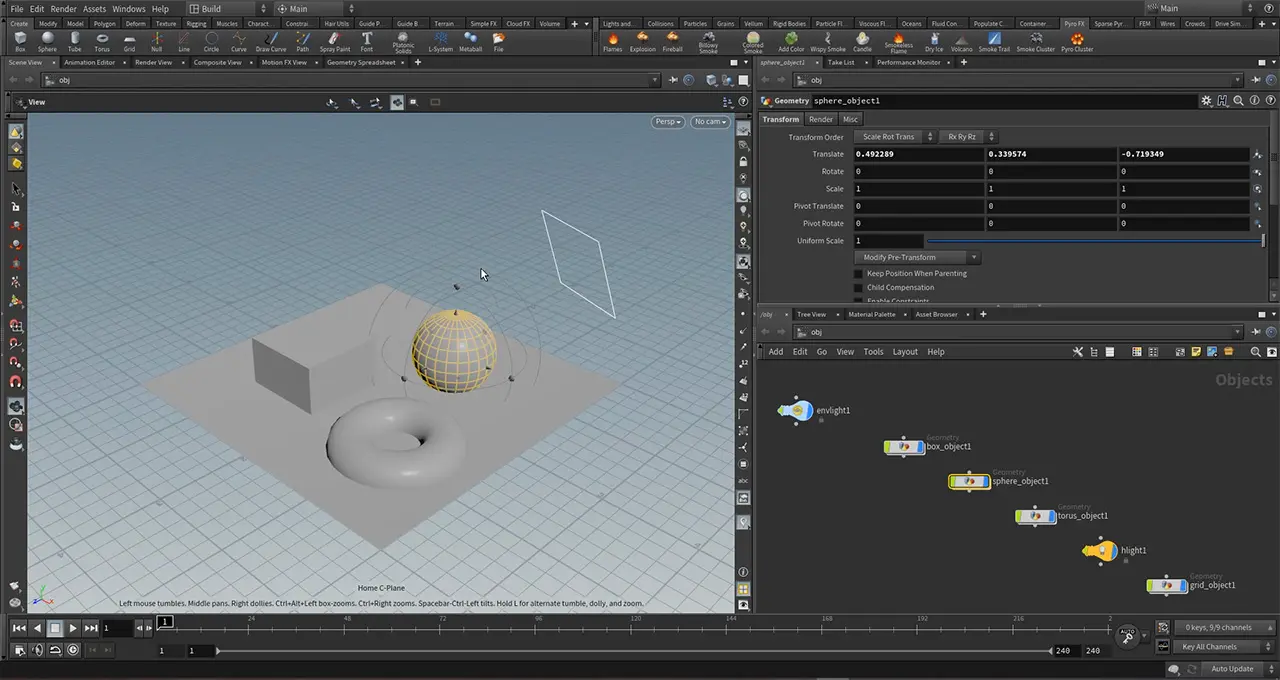
Having used Houdini for several years in a professional context, I've come to particularly appreciate its ability to handle complex procedural simulations. What I found particularly powerful was its flexibility in creating highly realistic effects that would be impossible to achieve with other software. It's procedural engine opens up almost limitless possibilities for VFX artists and motion designers.
Houdini excels particularly in contexts where precise manipulation of particles, fluids, fire or destruction is essential. It is therefore a major asset in film or advertising productions that demand impressive, controlled effects. Its procedural modeling tools automate many creative steps, increasing productivity.
However, although very powerful, Houdini presents a rather steep learning curve. It requires time and a certain amount of rigor to properly master all its features, which can be a hindrance for novice content creators or those looking for a quick solution for simple editing.
Is Houdini really useful for my needs?
The real question to ask yourself before adopting Houdini is: do I need an extremely powerful, yet complex tool that excels at creating advanced visual effects and procedural animations? If your project requires 3D simulations, realistic effects such as explosions, fluids, particles or even procedurally generated scenery, then Houdini is highly relevant.
This software is aimed at several profiles:
- VFX studios wishing to create sophisticated effects for films or commercials.
- Advanced motion designers who want to go beyond classic animation limits.
- 3D content creators who need powerful procedural tools to automate their scenes.
- Developers and technicians looking to integrate physical simulations into their workflow.
Another strong point of Houdini is its easy integration with other 3D software and production pipelines, making it highly suitable for demanding professional environments.

Is Houdini suitable for beginners?
Houdini is a tool clearly geared towards advanced users. For a beginner, getting to grips with it can seem intimidating due to its complexity and technical interface. However, the community is active, and SideFX offers numerous learning resources, tutorials and a free version called Houdini Apprentice that lets you get to grips with the basics at no cost.
For beginners, the simplest features such as basic modeling or certain procedural effects can serve as a gateway. That said, complete mastery of the tool requires a substantial investment of time and patience, especially to exploit the full potential of advanced simulations.
How much does Houdini cost?

Houdini offers several packages to suit different profiles, but its price is generally high compared with other motion design software. The standard commercial license is offered at around 960 USD per year, which includes all the main features, updates and technical support.
There's also a free version, Houdini Apprentice, ideal for enthusiasts and students who want to learn without constraints. This version is limited on certain commercial aspects and render resolution, but offers an almost complete experience of the software.
For professional studios with specific needs, SideFX offers Houdini FX, more comprehensive, incorporating advanced tools for complex simulations and pipeline integration, available by quotation or by more expensive annual subscription.
What are Houdini's key features?
A key feature of Houdini is its unique procedural engine, which enables content as diverse as animations, modeling and visual effects to be generated via independent nodes. This modular approach offers a very high degree of flexibility and reusability for manipulating complex scenes, modeling terrain, creating particles, fluids or explosions with fine-grained control.
Another key feature is the advanced physics simulation capability: fire, smoke, liquid, destruction and rigid body dynamics. These tools enable the production of realistic, cinematic-scale effects, widely used in the film and advertising industries.
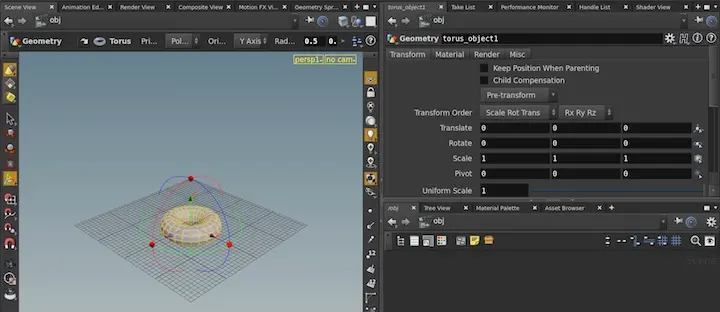
Among the advanced features, Houdini offers integrated rendering with Mantra and now Karma, rendering engines capable of rendering photorealistic images. These engines are optimized to handle the complex procedural scenes generated in the software.
The software also supports scripting via Python and VEX, giving advanced users the ability to create custom tools, automate repetitive tasks and integrate Houdini into customized production pipelines.
Despite its power, Houdini may not be suitable for every use case. For classic video editing or simple 2D animation, its complex interface and highly technical features can be a hindrance. The learning curve is long, limiting its adoption for creators who want a quick result without extensive training.
Competitors such as Adobe After Effects or Blender offer more accessible solutions for many uses. After Effects is particularly appreciated for its intuitive interface and varied plug-ins, while Blender offers a good free compromise for 3D. However, these alternatives are no substitute for Houdini's procedural power when it comes to complex effects.
In summary, Houdini's advantages are its power, flexibility and automation potential, but on the other hand, it requires a significant time investment. To make the right choice, you need to weigh these benefits against the constraints of use and your specific needs.
FAQS
Is it reliable and secure?
Houdini is reliable software, developed by SideFX, a reputable company in the 3D industry with over 20 years' expertise. The software's robustness is regularly tested in demanding professional contexts such as film productions, which demand rock-solid stability.
On the security side, Houdini is used in secure environments, with standard protocols for updates and license management. Project files are stored locally, giving users total control over their data.
It supports collaborative workflows via possible integrations with version control systems and other production tools.
Is it compatible with my other tools?
Houdini supports a wide range of standard 3D formats such as FBX, OBJ, Alembic, USD, enabling seamless interoperability with other modeling or compositing software. It also offers plugins and APIs facilitating its integration into custom pipelines.
Its dialogue with software such as Maya, Unreal Engine or Nuke is well-honed, reinforcing its place in cross-platform post-production and visual effects workflows.
Is there responsive customer support?
SideFX customer support is renowned for its responsiveness and relevance. Licensed users benefit from access to technical support with generally satisfactory response times. A wealth of online documentation and active community forums round out this support.
Training and support via official tutorials are also very comprehensive, making it easy to get up to speed.
What do other users think?
User reviews of Houdini generally emphasize its unrivalled power and flexibility, particularly appreciated by VFX professionals. Many praise the quality of the effects obtained and the modularity of the procedural engine. On the other hand, some beginners point to the complexity and difficulty of fully mastering the tool.
Feedbacks also emphasize the high cost and the need for a substantial learning commitment, which may make it a choice reserved for advanced users.
Can I easily change later?
User reviews of Houdini generally emphasize its unrivalled power and flexibility, particularly appreciated by VFX professionals. Many praise the quality of the effects obtained and the modularity of the procedural engine. On the other hand, some beginners point to the complexity and difficulty of fully mastering the tool.
Feedbacks also emphasize the high cost and the need for a substantial learning commitment, which may make it a choice reserved for advanced users.
Alternatives

Specializing in business creation, sales and digital marketing, he puts his expertise at the service of users to help them identify the solutions best suited to their needs. Passionate about digital innovation and optimizing online performance, Alexis is committed to providing detailed, transparent and unbiased comparisons.
Do you have an entrepreneurial project?
We support you in the structuring and development of your tech project. Make an appointment with one of our Business Strategists.