


.avif)





.svg)
.svg)




Dribbble has established itself, over the years, as the visual den for designers, a privileged spot to unveil your work and get inspired. But in 2025, with AI shaking things up and new platforms proliferating, does Dribbble still have a place in your creative arsenal? Simplicity, functionality, limits... I've been using Dribbble for several years now, and here I share my feedback and objective opinion on its real usefulness for your needs.
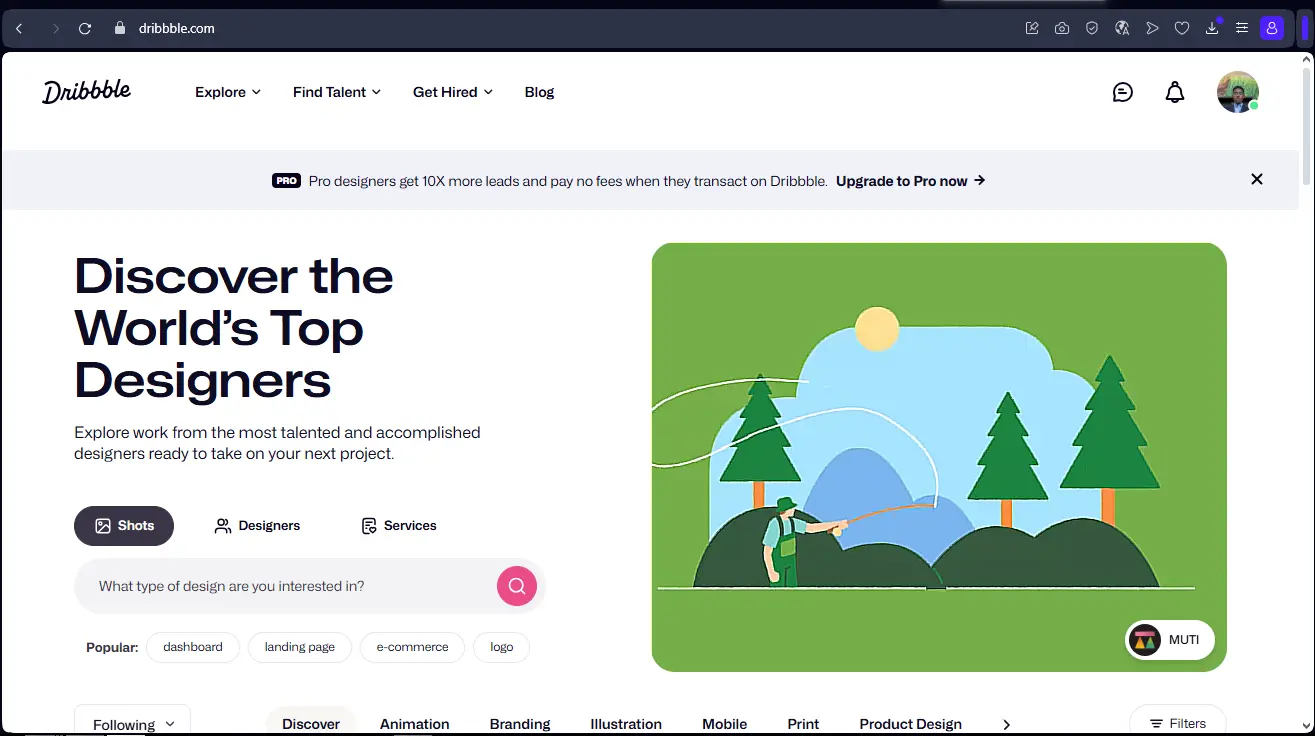
My experience with Dribbble
Since I started with Easy Web in 2020, Dribbble has always been an essential platform for our team and me. What I appreciate most of all is its unparalleled concentration of visual inspiration.
It's our first instinct when we're looking to push creative boundaries, whether for a UI/UX redesign or to capture the latest graphic trends. The quality of the productions shared is just bluffing and constantly feeds our vision. For brainstorming sessions or fine-tuning an artistic direction, Dribbble really excels.
However, you also need to be aware of its limitations. Dribbble is excellent for demonstrating finished "shots", but it often lacks the full context of the project, the actual challenges or iterations. It's more of a showcase than an in-depth collaborative workspace, which can give a sometimes idealized vision of design.
Is Dribbble really useful for my needs?
The real question to ask yourself before using Dribbble is: what's your purpose? Its relevance depends on your use. If your goal is to get inspired, catch trends or build an impactful portfolio, Dribbble is a great ally. For that, it's formidable.
UI/UX designer, freelance illustrator, or agency in search of talent: Dribbble is ultra-efficient. I've often consulted it to analyze interface approaches, unearth graphic styles, or spot profiles for Easy Web. It's a veritable visual goldmine.
.Dribbble isn't just about inspiration. It's an excellent springboard for getting relevant feedback on your creations. The community is engaged, and its feedbacks are a powerful lever for refining your work. This loop is essential for any designer.


Is Dribbble suitable for beginners?
When you're just starting out in design, inspiration is your best ally. Dribbble is a gold mine for that. Forget the blank page: here, you can explore thousands of "shots" - those little pieces of design that give a glimpse of other people's work. It's ideal for developing your eye, discovering different styles and understanding how the pros approach their projects. You learn by watching, which is powerful for sharpening your skills.
What's great for a beginner is this immersion. You don't have to post your own creations right away. The idea is to absorb, to see the best, to identify trends and industry standards. It's an incomparable visual learning platform, helping you to forge your own artistic sensibility and understand market expectations, without the pressure of performance.
How much does Dribbble cost?

Investing in the right tools is key, and Dribbble has segmented its pricing offerings well to suit everyone.
The "Dribbble Lite" package, often free or €5/month, is aimed at students and beginners. It offers a basic profile for displaying your creations and interacting with the community. Perfect for your first steps.
The "Dribbble Pro" plan, at around €20-25/month, targets experienced freelancers and small studios. It unlocks performance analytics, privileged access to the Job Board and private project features. An essential lever for your business and visibility.
For agencies and teams, the "Dribbble Studio" package, from €50-60/user/month, is a must. It includes robust collaborative tools, shared workspaces and advanced team management. It's the solution for scaling your projects and optimizing your collective workflows.
What are Dribbble's key features?
For me, Dribbble is above all this incomparable visual showcase. When you're looking for inspiration or want to present a concept quickly, these "shots" - these little snippets of design - are frighteningly effective. At Easy Web, we check in almost daily to catch new trends and see how other designers are solving creative challenges. It's a platform where visual quality comes first, and that's invaluable when you want to get straight to the point.
But beyond the simple gallery, Dribbble also excels at making connections. It's not just a place to deposit your creations; it's an active community where you can interact, give and receive constructive feedback. In fact, we've spotted and even recruited several exceptional talents via their dedicated job section. This collaborative dimension and the ability to network with peers are major assets, transforming Dribbble into a veritable hub of opportunities.

You know, Dribbble isn't just a storefront. What I've observed is that one of its most powerful features for agencies, like ours at Easy Web, lies in its recruitment and collaboration ecosystem. The "Hire Designers" or "Jobs" options aren't just bulletin boards; they enable ultra-targeted talent curation. We can refine our searches with precise filters by skills, location or even style, transforming the hunt for rare pearls into a surprisingly efficient process.
In the same vein, for designers who want to take things to the next level, the performance analysis tools offered to Pro accounts are formidable. Tracking the visibility of your "shots", understanding audience engagement, and identifying sources of traffic to your profile is fundamental. These detailed metrics aren't just numbers; they provide valuable insights for fine-tuning your content strategy and maximizing your professional impact on the platform. This is where Dribbble goes beyond a simple portfolio to become a strategic lever.
At Easy Web, we've seen it all: Dribbble is a nugget for rapid inspiration and talent discovery. But when it comes to demanding customer projects, real-time collaboration on prototypes or managing complex tasks, it quickly reaches its limits. It's not a tool for production or deep co-creation.
For these cases, we prefer platforms like Figma or Adobe XD, much better suited to advanced collaboration, or even a Behance for richer, more diversified portfolios. Dribbble retains enormous value for rapid sharing and lightning feedback on visual concepts. It has its place, but not everywhere.
Strengths:
- A huge source of visual inspiration
- Excellent visibility for designers
- Reactive community for feedback
Weaknesses:
- Limited collaboration on projects
- Not well suited to detailed project management
- Tendency to "dribble" styles (standardization)
FAQS
Is it reliable and secure?
Absolutely. As a design professional, your intellectual property is paramount. Dribbble has always delivered on this aspect. The platform uses robust security protocols, including SSL/TLS encryption to protect your data and transfers. Their infrastructure is designed for high availability (uptime), ensuring that your portfolios and projects are always accessible and secure. I've never had any major reliability issues with them. It's a solid foundation for exhibiting and collaborating, without worrying about the security of your work.
Is it compatible with my other tools?
That's a great question, and it comes up a lot! Dribbble, by its very nature, is not creative software. Rather, its "compatibility" lies in its ability to integrate with your portfolio presentation ecosystem. You won't find direct plugins to design on Dribbble from Figma or Sketch, because that's not its role. On the other hand, it does offer robust APIs for exporting and integrating your "shots" (your creations) on your personal site, Behance, or even certain project management tools. For us, this is a major asset for frictionless visibility with our design tools.
Is there responsive customer support?
When it comes to responsiveness, let's be clear: Dribbble's support is not comparable to a 24/7 real-time service. For routine questions, I find that their incredibly active community provides answers much more quickly. On the other hand, for critical issues - account access, major bugs or questions related to a Pro subscription - I've found that they do respond. This sometimes requires a little patience, but a reliable follow-up is generally assured. Don't expect an immediate response.
What do other users think?
In discussions with fellow designers and other agencies, the consensus is clear: Dribbble is a goldmine for quick visual inspiration and portfolio visibility. That's why we use it at Easy Web. However, the downside is that many find it too focused on the final rendering, neglecting the complete design process (user research, wireframing, etc.). This can sometimes lead to a "dribbble-like" style, highly aesthetic but lacking in functional depth. It's a showcase tool, essential for first impressions.
Can I easily change later?
In discussions with fellow designers and other agencies, the consensus is clear: Dribbble is a goldmine for quick visual inspiration and portfolio visibility. That's why we use it at Easy Web. However, the downside is that many find it too focused on the final rendering, neglecting the complete design process (user research, wireframing, etc.). This can sometimes lead to a "dribbble-like" style, highly aesthetic but lacking in functional depth. It's a showcase tool, essential for first impressions.
Alternatives
.svg)

Specializing in business creation, sales and digital marketing, he puts his expertise at the service of users to help them identify the solutions best suited to their needs. Passionate about digital innovation and optimizing online performance, Alexis is committed to providing detailed, transparent and unbiased comparisons.
Do you have an entrepreneurial project?
We support you in the structuring and development of your tech project. Make an appointment with one of our Business Strategists.