


.avif)





.svg)



Should Bubble be used in 2025?

Bubble has rapidly established itself as a major reference in the world of no-code development, offering web developers and agencies a feature-rich platform for creating web applications without writing a single line of code. Whether you're a seasoned professional looking to speed up your projects, or an agency wishing to offer rapid solutions to your customers, Bubble presents an attractive alternative to traditional methods. However, does the tool really meet all the expectations of modern developers?
In this article, we'll explore Bubble's strengths and weaknesses in detail, to help you determine whether it deserves a place in your development arsenal in 2025.
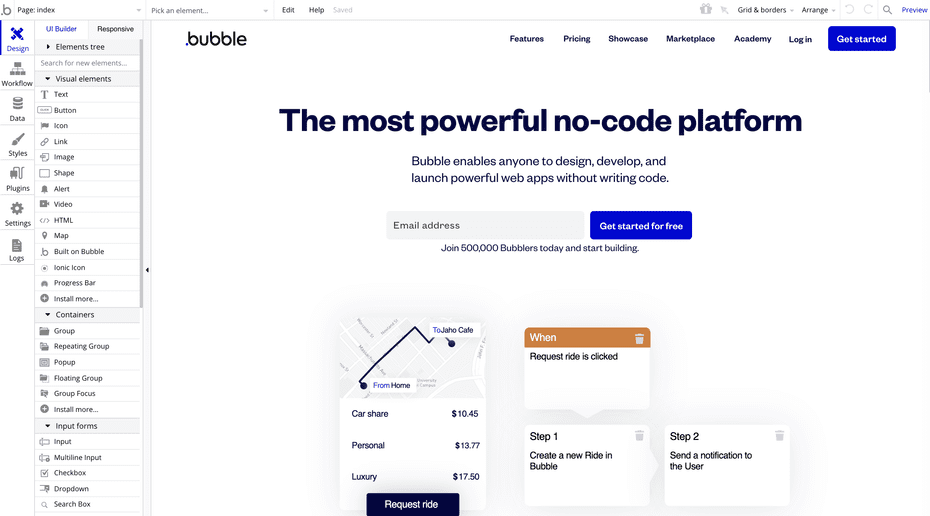
My experience with Bubble
I've been using Bubble both personally and professionally for several years, in particular to rapidly prototype complex web applications without going through conventional development. What I particularly appreciate about Bubble is its ability to create intuitive, interactive interfaces with **great flexibility in data management**.
Bubble excels above all in the context where you need to launch an MVP quickly, with extensive customization of workflows and varied integrations. Its visual approach facilitates collaboration between developers and customers, which is a real plus.
However, I note that Bubble can show its limits as soon as needs become very specific or scalability requires a more robust and optimized architecture. Its learning curve also remains a barrier for complete novices.
Is Bubble really useful for my needs?
The real question to ask yourself before adopting Bubble is to clearly define the type of project you want to run. Bubble is very well suited to MVP web applications, startups, management platforms, and functional prototypes.
The personas who find it of interest include:
- Developers who want to speed up their development process without sacrificing functional richness.
- Web agencies who need to quickly offer tailor-made solutions to a variety of customers.
- Entrepreneurs or non-developer project managers wishing to validate an idea without a large initial budget.
Another strong point of Bubble is its ecosystem rich in plugins and integrations, making it very easy to extend basic functionality without coding.

Is Bubble suitable for beginners?
Bubble can be a good choice for beginners, as its intuitive visual interface makes it easy to build applications without coding. Features such as drag-and-drop, visual workflows and ready-to-use templates make it easy to get started.
Furthermore, Bubble offers varied teaching resources, tutorials and an active community to help novices make rapid progress. Learning remains moderate, but accessible for those who take the time to explore the tool.
How much does Bubble cost?
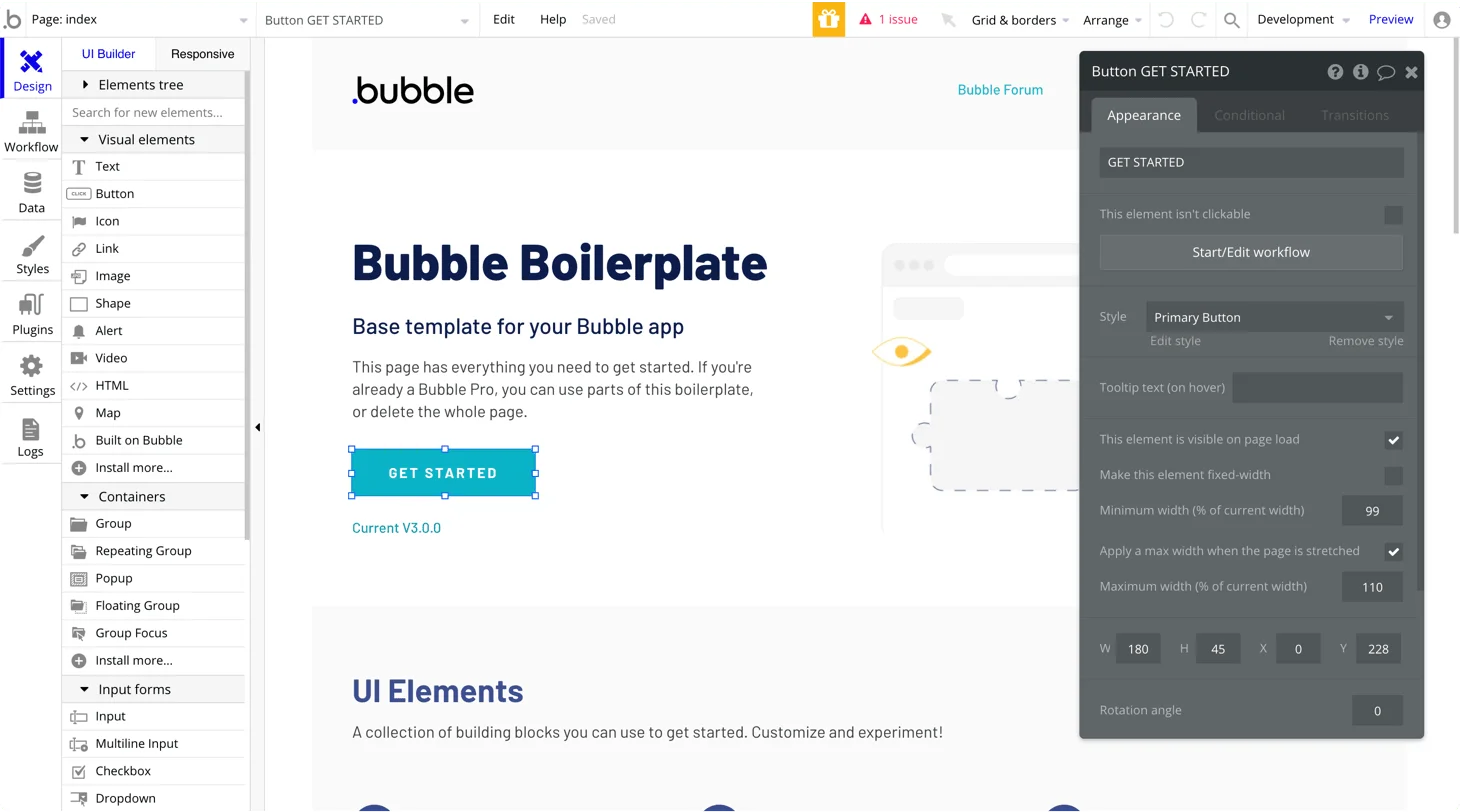
Bubble offers different packages to suit a variety of needs.
Free packages allow you to familiarize yourself with the platform, ideal for testing and prototyping at no cost, but with limitations in terms of performance and branding.
Paid packages start at around €25 per month, offering enhanced performance, access to premium plugins, and the option of connecting your own domain name. These plans are well suited to freelancers and small agencies wanting a more professional environment.
More advanced packages starting at €115 per month address the needs of enterprises, with dedicated server resources and advanced collaboration options.
What are Bubble's key features?
Bubble's first key feature is its powerful visual editor, which combines a drag-and-drop system with a visual workflow engine. This makes it possible to create complex user interfaces and logic without writing code.
The second major feature is integrated database management. Bubble offers a complete tool for intuitively defining, storing and manipulating data, facilitating the creation of dynamic applications that interact with users in real time.
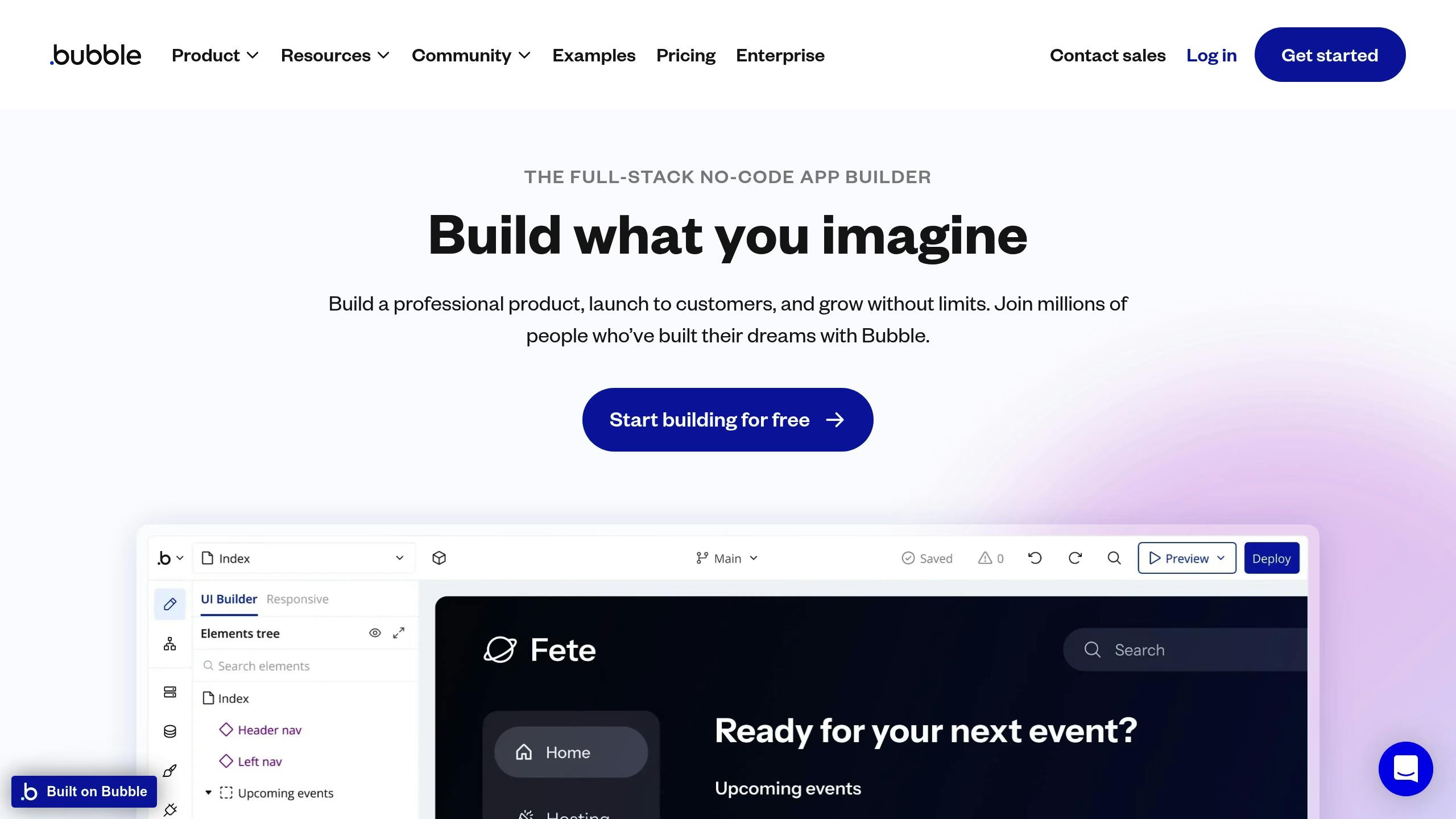
Bubble also offers advanced features such as integration via API, enabling the application to be connected to external services to enrich the user experience.
Furthermore, the tool offers the possibility of deploying customized versions for different users, with role management and security, making the applications created truly professional and adapted to various use cases.
Bubble has certain limitations depending on the use case. For example, for applications requiring optimal real-time performance, or for systems with very high user volumes, Bubble may be less suitable.
In these situations, more traditional or specialized tools such as React.js, Vue.js, or dedicated backend frameworks might better meet expectations, while remaining positive about Bubble's no-code advantage that accelerates prototyping.
Despite these constraints, Bubble offers an excellent compromise for many projects, with advantages such as rapid implementation and an active community, counterbalanced by limitations in scalability and advanced customization.
FAQS
Is it reliable and secure?
Bubble is a reliable platform that focuses on data security and the robustness of its infrastructures. It uses standard security protocols such as HTTPS and encryption of data at rest and in transit.
Servers are hosted on recognized cloud infrastructures guaranteeing high availability and regular backups. Bubble also offers granular access controls to secure the applications developed.
However, as with any no-code tool, it is advisable to apply good security practices at the application design level, particularly for sensitive data.
Is it compatible with my other tools?
Bubble is compatible with numerous services via native integrations or APIs. It supports standard formats for importing/exporting data and can be connected to third-party tools to extend its capabilities.
The tool also enables the deployment of web applications accessible on all modern browsers and mobile devices, ensuring a wide scope of use.
Is there responsive customer support?
Bubble customer support is available via a comprehensive knowledge base, an active community forum, and ticket support for paying users.
Response times are generally fast, and the service is appreciated for its efficiency and responsiveness, making it easy to resolve any problems encountered.
What do other users think?
User reviews of Bubble often praise its ease of use and the speed with which a project can be launched.
Positive points highlight the functional richness and flexibility. Some negative feedback mentions the initial learning curve and scalability limitations for very complex projects.
.Can I easily change later?
User reviews of Bubble often praise its ease of use and the speed with which a project can be launched.
Positive points highlight the functional richness and flexibility. Some negative feedback mentions the initial learning curve and scalability limitations for very complex projects.
.Alternatives
.svg)

Specializing in business creation, sales and digital marketing, he puts his expertise at the service of users to help them identify the solutions best suited to their needs. Passionate about digital innovation and optimizing online performance, Alexis is committed to providing detailed, transparent and unbiased comparisons.
Do you have an entrepreneurial project?
We support you in the structuring and development of your tech project. Make an appointment with one of our Business Strategists.