


.avif)





.svg)



Should Baserow be used in 2025?

Baserow is positioned as an innovative and accessible solution in the world of no-code databases, aiming to simplify data management and collaboration for developers and technical teams. In the face of the complexity sometimes engendered by traditional systems, Baserow offers an intuitive interface for creating, modifying and sharing customized databases without requiring in-depth skills in SQL or database administration. But how does this tool actually meet the needs of web agencies and professional developers? This article offers a comprehensive analysis of Baserow, exploring its potential, features and limitations to help you decide whether it can effectively integrate your toolbox in 2025.
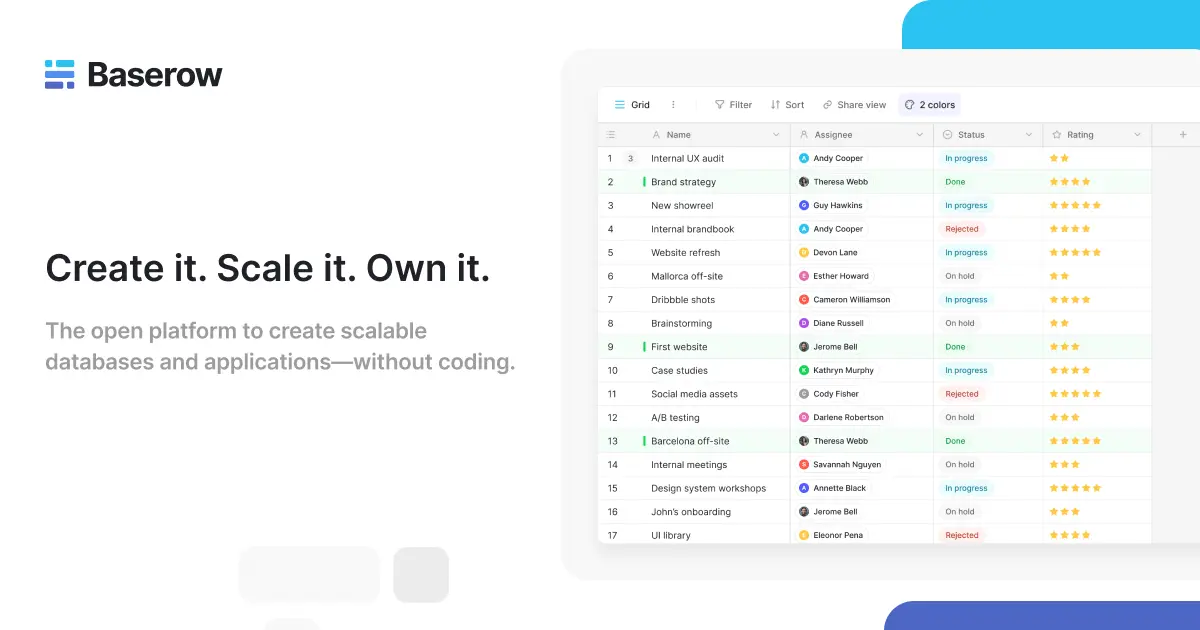
My experience with Baserow
I use Baserow mainly in a professional context to manage projects with teams that aren't all technical. What immediately struck me was the **simplicity of use** and the ability to easily centralize data without coding. This facilitates interdisciplinary collaboration.
In a context where speed and agility are key, Baserow is particularly effective for agile data management, especially for simple workflows or rapid prototyping. Its web interface makes it easy to get to grips with, which is a real plus when it comes to saving time.
However, Baserow shows its limitations when databases become highly complex or heavily integrated with advanced backend systems. Its lack of certain advanced SQL functionalities or fine-grained permissions management can be a hindrance for more critical or large-scale projects.
Is Baserow really useful for my needs?
The real question to ask is: do I need a database that's easy to learn, collaborative and accessible without advanced development skills? If the answer is yes, Baserow can be a great option.
Here are just a few examples of personas who could benefit from Baserow:
- Web agencies who want to manage project inventories, clients or tasks without technical complexity.
- Developers wanting to quickly prototype a functional database for testing.
- Marketing or product teams who need a tool to classify and organize data without depending on developers.
Another strong point is the self-hosting capability, which guarantees more control over data and flexibility of integration with other tools.

Is Baserow suitable for beginners?
For a beginner, Baserow is extremely welcoming thanks to its intuitive interface built on no-code principles. Drag-and-drop functionality, clear tabular visualization and direct cell editing make learning fast and enjoyable.
In addition, pre-built templates and accessible documentation make it much easier for those new to database management to get the hang of things. In practice, a novice developer or non-technical project manager will easily find their bearings in organizing data efficiently.
How much does Baserow cost?
Baserow is mainly free, which is a major advantage for small teams or personal projects. This gratuity includes access to the open source version, which you can deploy yourself, with no limitation on functionality.
For companies looking for a hosted solution with support, Baserow offers paid packages, often based on the number of users or storage capacity, but in this version, simplicity and no-code remain at the heart of the experience. This pricing flexibility is ideally suited to agencies of varying sizes and developers wishing to test without commitment.
What are Baserow's key features?
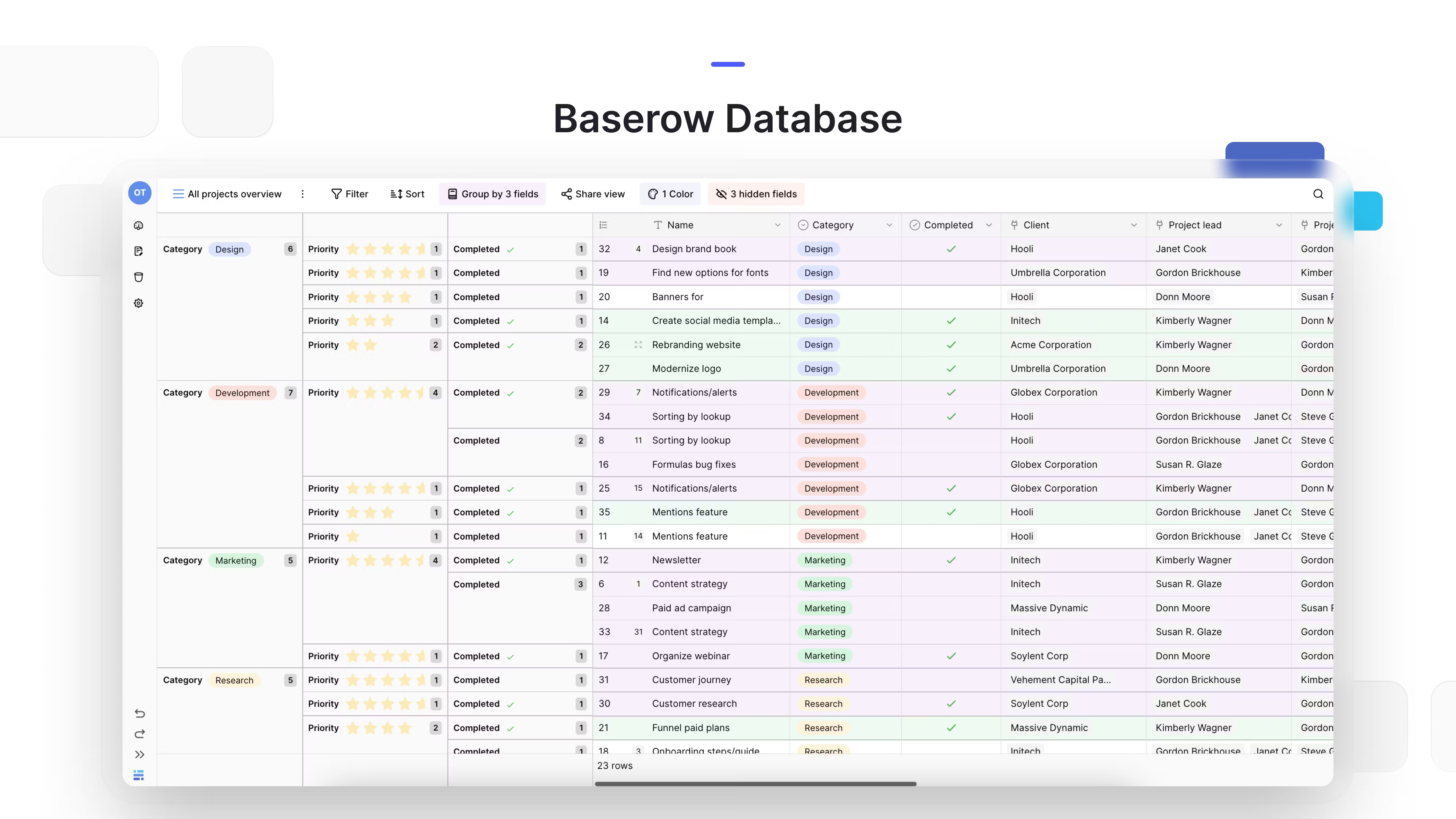
Baserow's number-one key feature is its ability to create relational databases via a no-code interface, enabling simple relationships between tables to be established without writing a single line of code. This vision democratizes complex data management for non-technical users.
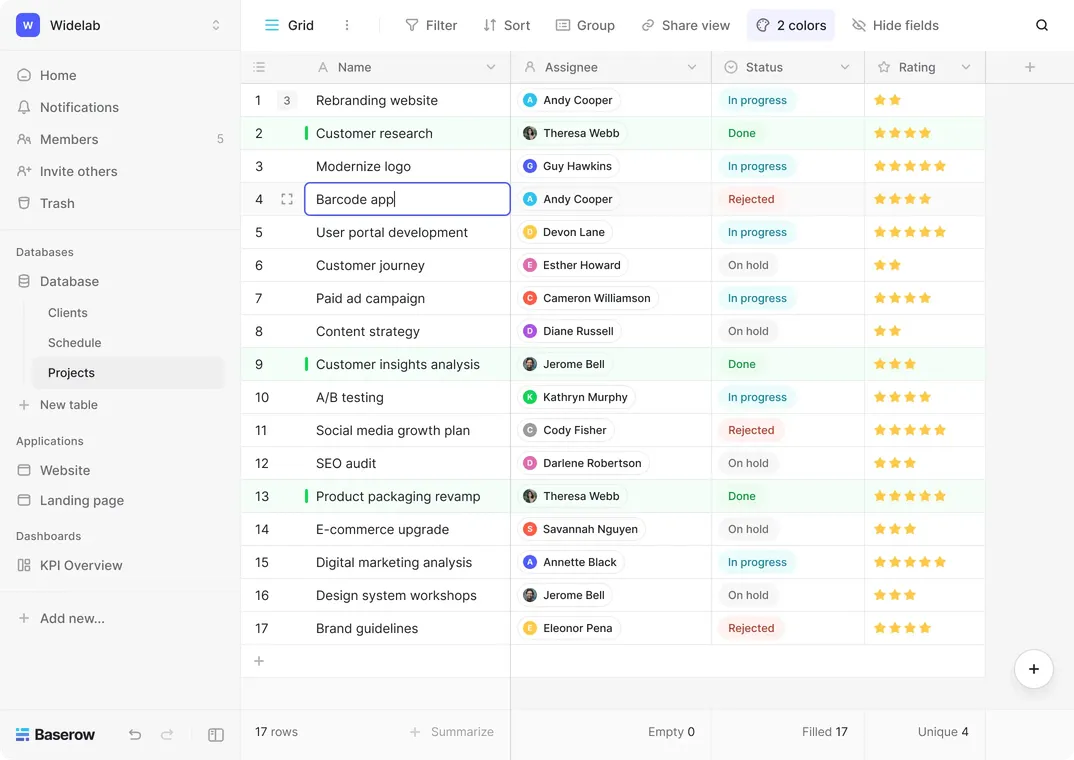
Another essential feature is real-time collaborative editing. Multiple users can work simultaneously on the same database, facilitating information sharing and team coordination, which is crucial for web agencies.
Advanced features include API integration that allows developers to connect Baserow to other tools or services, ensuring fluidity in automated workflows.
Furthermore, Baserow offers a system of customizable formulas and filters to manipulate and display data according to precise criteria, offering advanced customization while remaining accessible.
.Baserow is not designed to replace robust database management systems such as PostgreSQL or MySQL in very complex or data-intensive contexts. Its features are perfect for no-code and simplicity, but scalability can become an obstacle.
Faced with these limitations, competitors such as Airtable, Notion or even more classic databases with graphical interfaces can be considered depending on requirements. Each of these tools has its own specificities, but Baserow stands out for its open source offering and ease of deployment.
In summary, Baserow offers an excellent compromise between user-friendliness and power for moderate needs, but it's important to carefully assess its limitations for more demanding uses. Advantages: simplicity, collaboration, open source; Disadvantages: limited scalability, advanced features absent.
FAQS
Is it reliable and secure?
Baserow is reliable and secure, relying on the robustness of open source technologies and the possibility of self-hosting, which confers total control over data. The HTTPS protocol is standard for secure exchanges between client and server.
In addition, regular updates ensure protection against known vulnerabilities. On the application security side, access permissions can be finely configured according to roles, although this management is still perfectible for very complex environments.
Is it compatible with my other tools?
Baserow is compatible with numerous integrations thanks to its open API. It supports the import/export of common formats such as CSV, enabling easy adaptation to existing tools.
Self-hosting also favors deep integration into the corporate IT ecosystem, enabling Baserow to be connected with internal systems or various cloud platforms.
Is there responsive customer support?
Baserow's customer support performs well via standard channels such as the community forum, online documentation and email support for paid offers. Response times are generally fast, and the content of answers is relevant and resolution-oriented.
What do other users think?
User reviews highlight the ease of use and flexibility offered by Baserow, appreciated mainly in small teams and agile projects. The negative points often mentioned concern scalability limitations and the lack of advanced features dedicated to complex databases.
Can I easily change later?
User reviews highlight the ease of use and flexibility offered by Baserow, appreciated mainly in small teams and agile projects. The negative points often mentioned concern scalability limitations and the lack of advanced features dedicated to complex databases.
Alternatives
.svg)

Specializing in business creation, sales and digital marketing, he puts his expertise at the service of users to help them identify the solutions best suited to their needs. Passionate about digital innovation and optimizing online performance, Alexis is committed to providing detailed, transparent and unbiased comparisons.
Do you have an entrepreneurial project?
We support you in the structuring and development of your tech project. Make an appointment with one of our Business Strategists.