


.avif)





.svg)
.svg)



Should Make (formerly Integromat) be used in 2025?

Make (formerly Integromat) is a powerful automation platform for content creators, videographers, editors, marketing agencies and production studios looking to optimize their workflows. The tool connects a variety of applications to automate repetitive tasks, without requiring advanced programming skills.
In a world where efficiency and speed are major assets, Make is establishing itself as an essential facilitator. But how do you properly integrate this solution to maximize its potential? We'll explore its features, benefits and limitations to help you decide whether Make is right for your needs in 2025.
My experience with Make (ex Integromat)
I use Make mainly in a professional context to automate workflows between various applications, particularly in video content management and coordination with marketing teams. What impresses me most about Make is its integration capability and flexibility in creating automation scenarios, which is its major strength.
In complex projects where several tools need to communicate with each other, Make particularly excels. Its visual interface makes it easy to follow the flow of data, helping to optimize processes and avoid human error. This is a real time-saver, especially for studios or agencies with busy production pipelines.
However, the learning curve may impress some beginners, especially for advanced scenarios with numerous steps and conditions. What's more, the pricing system quickly becomes onerous if your volume of operations is high, which can be a drag for smaller structures or freelancers on tight budgets.
Is Make (ex Integromat) really useful for my needs?
The real question to ask when considering Make is whether automating your processes can really free up time and increase your productivity. For some profiles, it's a powerful, game-changing lever.
Make is ideally suited to content creators wanting to automate multi-platform publishing, editors wanting to synchronize their editing software with project management tools, or marketing agencies needing to connect CRM, mailing campaigns and social networks. For example, a videographer can automate the sending of files to a cloud as soon as editing is complete, while a marketing agency activates workflows linked to lead management.
One of Make's other strengths lies in its compatibility with a very large number of applications, enabling extensive customization of workflows according to specific needs. This makes it a versatile tool suitable for a wide range of professional users looking for more than just basic automation.


Is Make (formerly Integromat) suitable for beginners?
Make can be perfectly adapted to beginners, even if initial familiarization requires a little time to master the interface and scenario logic. Features such as pre-designed templates and the visual interface make it easy to understand and create simple automations.
For a novice, it's also an excellent way to gradually learn how to automate tasks, thanks to built-in tutorials and an active community. Beginners thus benefit from a progressive experience that allows them to increase their skills while easily visualizing the impact of their automations.
How much does Make (formerly Integromat) cost?
Make offers an interesting free version that allows you to create several scenarios with a limited monthly quota of operations, ideal for testing the tool or for less intensive use.
The first paid plan starts at $9 per month and includes a higher number of operations as well as additional features such as premium connections and more frequent scenarios. This plan is suitable for small teams or freelancers with a moderate volume of automations.
For users requiring significant capacity, there are superior formulas with much higher quotas and advanced capabilities, but the cost can quickly climb, requiring a precise assessment of needs to optimize ROI.
What are the key features of Make (formerly Integromat)?
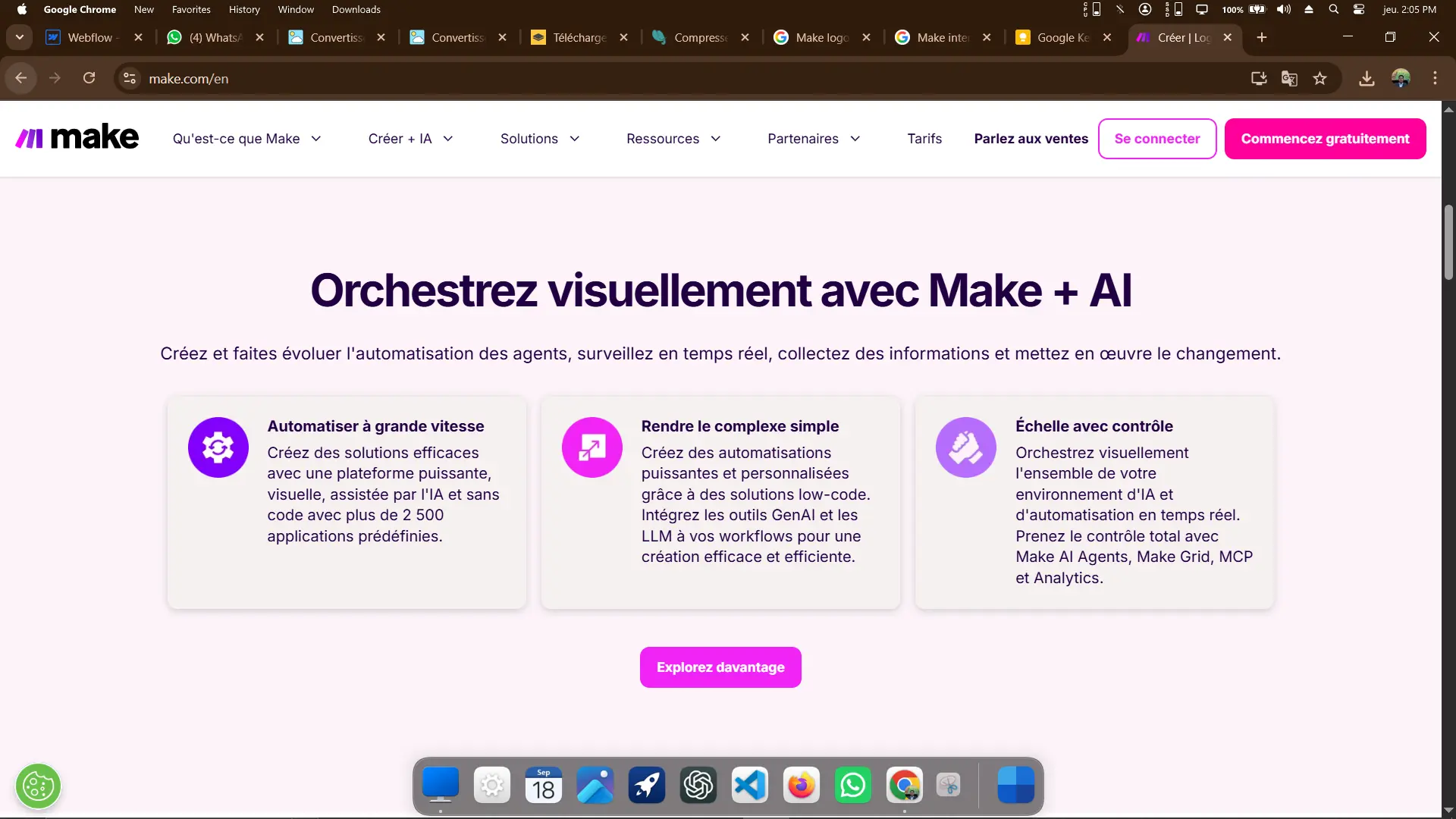
Make's first key feature is its intuitive visual interface based on modular scenarios. Users can create automated workflows by easily connecting various applications via a system of modules, with a clear visualization of the data flow that facilitates design and monitoring.
Then, Make offers a very wide range of integrations with more than 1,000 popular applications such as Google Drive, Dropbox, Slack, Airtable and many more, making it possible to deeply customize automations according to the specific needs of each professional.
.
Beyond the basic functionality, Make allows you to manage complex scenarios thanks to advanced options such as conditions, loops and custom functions that can adapt to sophisticated business processes.
Furthermore, the tool offers the ability to create webhooks and custom APIs, opening the door to tailor-made integration with in-house applications or proprietary systems, reinforcing the platform's flexibility and power.
.Like any tool, Make has certain limitations that can slow down its adoption depending on the use case. For very simple workflows, setup can seem complex and a little cumbersome. Users looking for an ultra-fast solution without advanced configurations might prefer more straightforward alternatives.
In comparison, competitors such as Zapier or Automate.io may be more accessible to beginners, albeit less powerful at scale. However, Make remains highly competitive thanks to its depth of functionality, which remains a major advantage for complex needs and fine-tuned integration.
To sum up, Make offers plenty of power, but its ergonomics will take some getting used to. Its advantages lie in the flexibility and richness of possible connections, but at the price of a higher learning curve and modulated pricing according to usage, which can be a hindrance when faced with certain simpler, more economical solutions.
>Make is the ideal solution for all your needs.FAQS
Is it reliable and secure?
Make is a reliable, secure platform that uses standardized protocols such as HTTPS and OAuth to guarantee secure exchanges and user authentication. Data is encrypted between services, ensuring a high level of confidentiality.
In addition, Make implements regular backups and continuous monitoring of its infrastructures, reinforcing the robustness of the service and minimizing the risks of interruption or data loss. The support team is also proactive in responding to any incidents.
Finally, users can finely manage access thanks to advanced security settings, including permissions and role management, indispensable in demanding professional environments.
Is it compatible with my other tools?
Make offers extensive compatibility with numerous formats and applications thanks to its native integrations and APIs. Whether for processing files, structured data or connecting with cloud tools, the tool meets the varied needs of professionals.
In particular, it supports common formats such as CSV, JSON, XML, and facilitates connection with databases, CRM, messaging services and cloud platforms, making it a highly flexible solution in a heterogeneous digital environment.
Is there responsive customer support?
Make's customer support is renowned for its responsiveness and quality. Users benefit from assistance by email and via a comprehensive resource center including FAQs, guides, tutorials and an active community for exchanging and sharing solutions.
Response times are generally short, and support is able to accompany both beginners and advanced users, which promotes efficient handover and rapid problem resolution.
Make's customer support is renowned for its responsiveness and quality.What do other users think?
User reviews often highlight Make's power and flexibility, as well as the richness of its integrations, as major strengths. Users particularly appreciate the intuitive visual interface, which facilitates the design of customized scenarios.
On the other hand, criticisms mainly concern the initial complexity and pricing, which can become costly with volume, especially for smaller structures. However, the majority recognize that the productivity benefits far outweigh these constraints.
Can I easily change later?
User reviews often highlight Make's power and flexibility, as well as the richness of its integrations, as major strengths. Users particularly appreciate the intuitive visual interface, which facilitates the design of customized scenarios.
On the other hand, criticisms mainly concern the initial complexity and pricing, which can become costly with volume, especially for smaller structures. However, the majority recognize that the productivity benefits far outweigh these constraints.
Alternatives
.svg)

Specializing in business creation, sales and digital marketing, he puts his expertise at the service of users to help them identify the solutions best suited to their needs. Passionate about digital innovation and optimizing online performance, Alexis is committed to providing detailed, transparent and unbiased comparisons.
Do you have an entrepreneurial project?
We support you in the structuring and development of your tech project. Make an appointment with one of our Business Strategists.