.avif)





.svg)
.svg)



Table of Contents


Published on
5/3/26
-
5 min
The implementation of AI agents in businesses is generating growing interest, but also raising many questions. Many organizations recognize the potential of AI agents without always knowing where to start or how to turn an idea into an operational project. Between isolated experimentation and large-scale deployment, the path to action often remains unclear.
This article is a direct continuation of the key article What is an AI agent? Definition, how it works, and concrete examples, which lays the conceptual foundations necessary for any structured approach. Here, the objective is no longer to define, but to show how to organize a realistic, progressive implementation that is adapted to the context of the company. The challenge is to move from understanding to action, without falling into an overly technical approach or rushed automation.
Implementing an AI agent always begins with scoping. This step is crucial, as it determines the relevance of the project and its ability to produce real value. An AI agent is only useful if it meets a clearly identified need and fits into a controlled framework.
The first question to ask is about the objectives. It is not a matter of defining a vague or abstract objective, but of identifying a concrete problem that the AI agent could help solve. The more precise the objective, the easier it will be to manage the implementation. An AI agent designed without a clear objective risks becoming an underutilized or unsuitable tool.
The choice of scope is equally important. A common mistake is to try to automate too many things from the outset. Too broad a scope complicates the design, lengthens lead times, and increases the risk of failure. Conversely, a limited scope allows you to test the approach, learn, and adjust before considering an extension.
Points to watch out for at this stage:
This scoping work is not a constraint. On the contrary, it provides a solid foundation for building a coherent and scalable project.
The success of an AI agent depends more on the method than on the technology. A gradual approach limits risks, promotes internal ownership, and allows the solution to be adjusted based on real feedback. This method can be divided into several complementary phases.
The exploration phase consists of analyzing the existing context. This involves observing processes, identifying points of friction, and understanding how an AI agent could be integrated without disrupting the organization. This phase also helps clarify expectations and define realistic success criteria.
Next comes the design phase. This aims to formalize the role of the AI agent, its responsibilities, and its limitations. At this stage, the agent is conceived as a participant in the process, with a defined scope of action. This clarification avoids misunderstandings and facilitates alignment between stakeholders.
The testing and adjustment phase is essential. An AI agent should not be deployed on a large scale without prior validation. Testing allows its behavior to be observed, its usefulness to be measured, and areas for improvement to be identified. This phase favors an iterative approach rather than a fixed deployment.
Finally, the deployment phase occurs when the AI agent has demonstrated its relevance within a limited scope. Deployment is generally accompanied by support for teams and a gradual adaptation of uses.
Key steps in a progressive method:
This approach makes the process secure while leaving room for learning.
The question of tools often arises too early in AI agent projects. However, an effective approach is to distinguish between method and technology. Tools are only means to an end and serve a given organization.
It is useful to distinguish between tools, functional building blocks, and complete systems. An AI agent can rely on several components, but it is the rules of operation and integration that determine its value. Choosing a tool without clarifying the role of the agent often leads to inappropriate choices.
Business context must guide decisions. Organizational constraints, internal skills, and existing processes strongly influence the choice of solutions. A tool that performs well in one environment may prove ineffective in another.
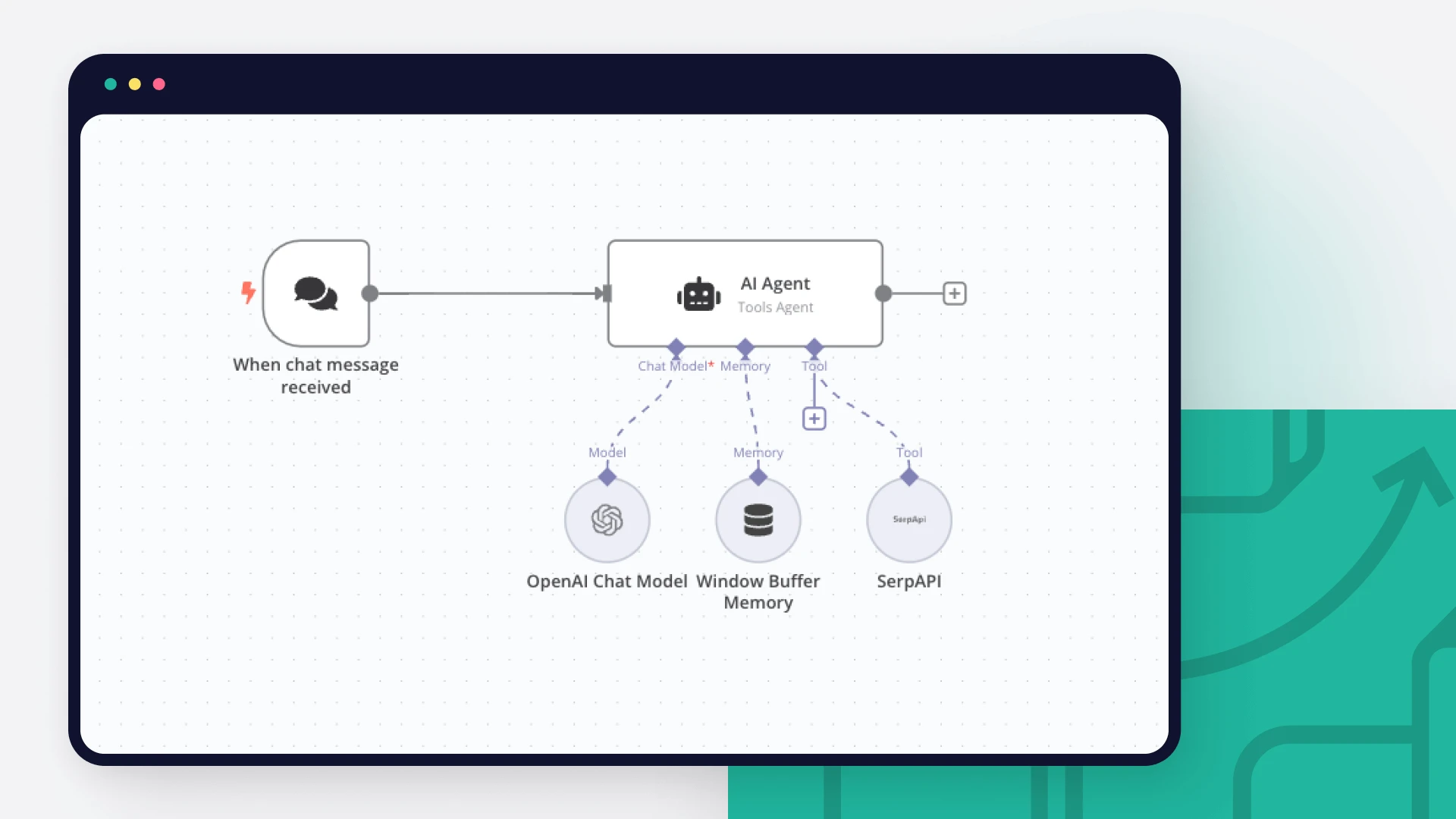
In practice, an AI agent almost always relies on automation tools capable of orchestrating actions, triggering decisions, and connecting different systems together. Solutions such as n8n, Make, and Zapier are frequently used to structure these sequences, as they allow complex logic to be modeled without relying on heavy development. Their role is not to make the agent intelligent, but to give it a clear and controlled framework for action.
Implementing an AI agent is not a one-off project. To be sustainable, it must be part of a coherent organizational dynamic. Team involvement is a key factor for success.
Employees must understand the role of the AI agent and the value it brings. An agent that is perceived as opaque or imposed will generate resistance. Conversely, clear communication promotes acceptance and ownership.
Governance also plays a central role. It is important to define clear responsibilities, particularly with regard to monitoring, developing, and evaluating the AI agent. Without governance, the agent risks becoming a marginal or obsolete tool.
Measuring the value created should not be overlooked. This does not necessarily involve complex figures, but rather simple indicators that can be used to assess the agent's real usefulness. This measurement informs decisions about adjustments and development.
Best practices to prioritize:
Sustainable adoption depends on alignment between technology, organization, and usage.
Certain mistakes recur regularly in AI agent projects. Identifying them allows you to avoid them and adjust your approach upstream.
The first mistake is to underestimate the scoping phase. A project launched without clear objectives or a defined scope is likely to quickly go off track. A lack of scoping often leads to unrealistic expectations.
Another common mistake is over-automation. Trying to automate too many decisions or tasks from the outset can undermine the quality of the project. A gradual approach is generally more effective.
Finally, neglecting human acceptance is a major obstacle. An AI agent does not replace teams. It assists them. Ignoring this human dimension compromises the adoption and sustainability of the project.
Common mistakes to avoid:
Implementing an AI agent in a company requires, above all, a clear, progressive approach that is tailored to the context. Defining objectives, choosing a controlled scope, integrating the agent into existing processes, and implementing appropriate governance are the real keys to success. Technology, while necessary, remains secondary to organization and methodology.
To complement this approach, we recommend returning to the article What is an AI agent? Definition, operation, and concrete examples, in order to consolidate the conceptual foundations. To structure and deploy an AI agent that is truly useful to your teams, Easyweb supports companies in a methodical approach, aligned with their business and organizational challenges.