


.avif)





.svg)



Should Retool be used in 2025?

.svg)
Retool has established itself as a leading tool for rapid internal application development and automation within technical teams and web agencies. By combining an intuitive visual interface with connections to external databases and services, it enables developers to rapidly create powerful interfaces without starting from scratch. In a world where agile prototyping and workflow management are becoming essential, Retool offers a pragmatic and robust solution.
But is it really suitable for all types of projects and teams in 2025?That's what we'll explore in this detailed article, drawing on my experience and analysis of the tool's strengths and limitations.
My experience with Retool
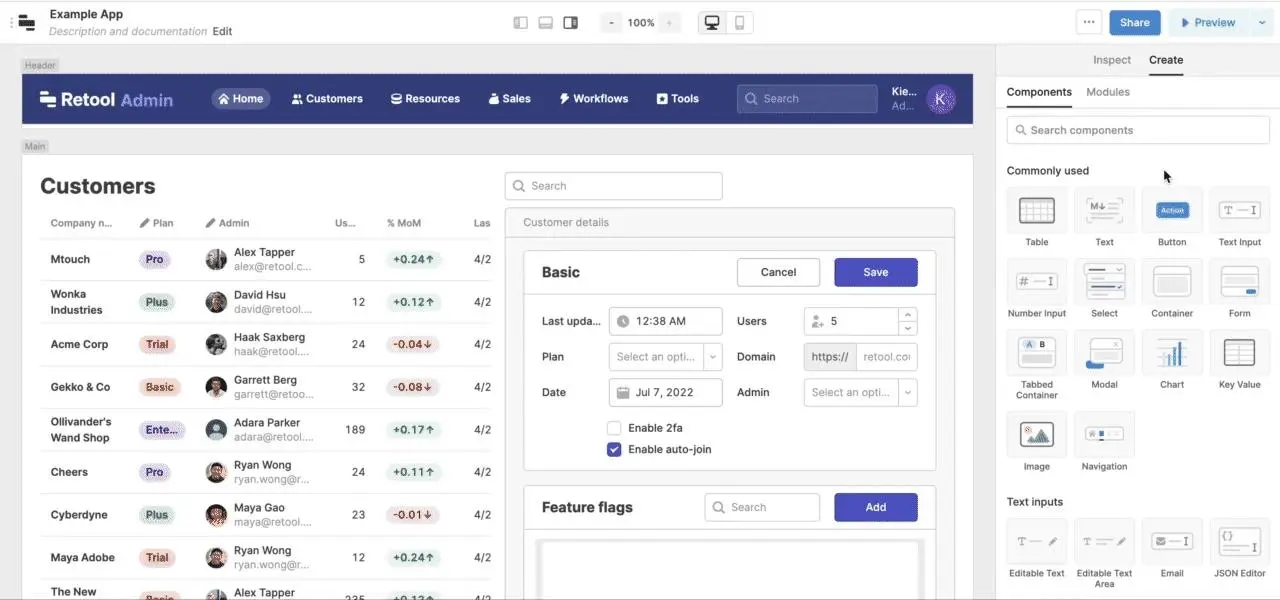
I use Retool mainly in a professional context, to quickly develop customized internal tools tailored to the specific needs of my agency clients. What I particularly appreciate is the ability to easily interface various data sources and build effective user interfaces without starting from scratch, which greatly accelerates development.
Retool excels above all in contexts where you need to quickly make dashboards, content managers or forms integrated with third-party APIs, without the weight of a full framework. It's a great ally for functional prototypes and rapid iterations, which can then be refined or integrated into larger systems.
However, it has certain limitations when it comes to advanced customization or management of highly complex interfaces, which often require bespoke code. The tool is therefore best used for targeted applications and with developers capable of managing the constraints inherent in this low-code approach.
Specifically, we recommend the use of a low-code tool.
Is Retool really useful for my needs?
The real question to ask before adopting Retool is whether your need lies in the rapid creation of internal tools or automations. Retool is not a platform for building consumer applications, but rather a solution for developers or internal teams wishing to create dashboards, manage databases, or automate business flows.
More concretely, Retool is aimed at several key personas:
- Full stack developers who want to save time on administration interfaces.
- Product teams who need functional rapid prototypes.
- Web agencies that need to deliver in-house customer solutions without starting from scratch.
- Data analysts wanting to easily visualize and manipulate data.
In addition to this, another strong point of Retool is its ability to connect to virtually any data source, whether SQL databases, REST APIs or cloud services, making it a versatile tool in the developer ecosystem.

Is Retool suitable for beginners?
For a beginner, Retool is fairly accessible thanks to its drag-and-drop interface and the ability to visually combine data sources. Features such as data binding and permissions management are designed to be usable without in-depth development knowledge.
However, to take full advantage of Retool, a minimum knowledge of JavaScript and databases remains advisable. But getting started is relatively straightforward, and the tool offers a good gateway to understanding automation and business interface construction without starting from a blank sheet of paper.
Retool is designed to be used without in-depth development knowledge.
How much does Retool cost?
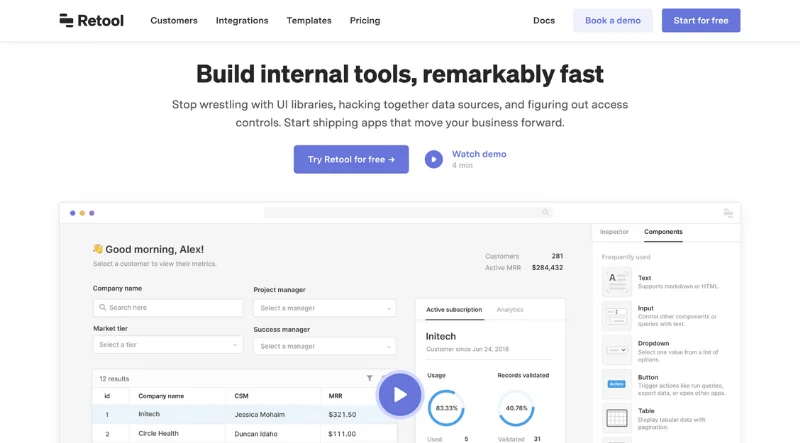
Retool offers several packages to suit different needs:
Team Plan at €20/month per user: Full functionality for data source access, team collaboration, API access, and intermediate customization. This plan is ideal for small to medium-sized teams who want to standardize their internal tools without too many technical complications.
Plan Business (pricing on quotation): For organizations with advanced security requirements, LDAP integration, dedicated support, and advanced user management. This plan is aimed primarily at companies and agencies with major business needs and regulatory constraints.
What are Retool's key features?
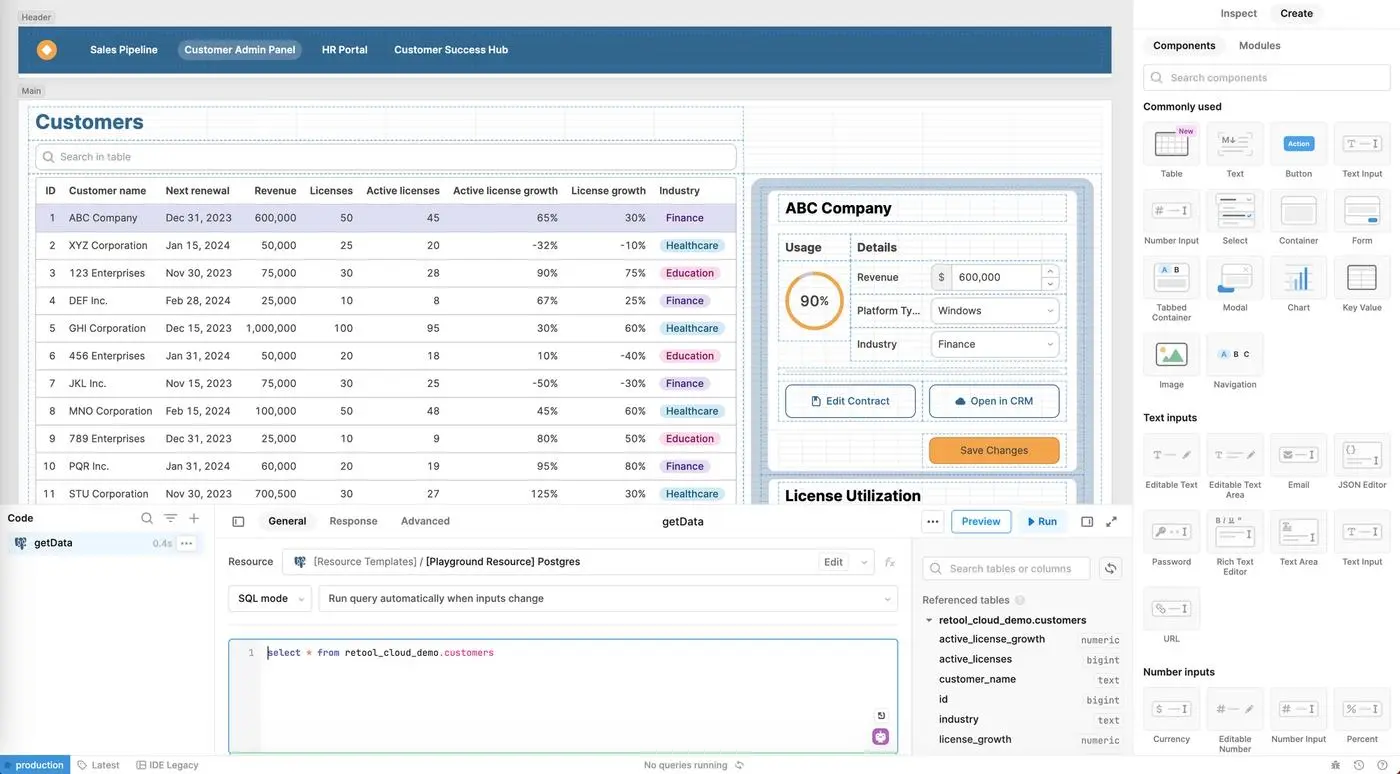
A major key feature of Retool is its ability to quickly and easily connect various databases (MySQL, PostgreSQL, MongoDB, etc.) and APIs, enabling developers to centralize distributed data in a single operational interface. This makes it much easier to create custom dashboards and forms without writing a lot of backend code.
Another flagship feature: the intuitive drag-and-drop interface that lets you build internal applications quickly, combining UI components (buttons, tables, graphics) with dynamic queries and automated workflows. This low-code approach accelerates development cycles while retaining the flexibility to add code when needed.
.
Among Retool's advanced features is fine-grained authorization management to control who can see or modify which data within applications, which is crucial for secure enterprise environments.
Then Retool offers directly integrated JavaScript and SQL scripting capabilities to extend business behaviors and logic, offering advanced customization while remaining within the low-code environment. These options make it possible to go beyond simple static interfaces to build truly dynamic and interactive tools tailored to specific needs.
Retool quickly shows its limitations depending on the use case. For applications requiring a highly personalized and responsive user interface, or a sophisticated user experience, Retool can show constraints particularly in the fine management of design and JavaScript interactions.
On the market, competitors like Appsmith, Budibase or even more traditional frameworks like React or Vue.js remain relevant depending on customization and scaling needs. These options may be preferable if you want total control over front-end code.
Retool's advantages include ease and speed of implementation, its wide range of integrations and a good learning curve compared to traditional frameworks. On the other hand, its main drawbacks are limited customizability and dependence on a proprietary platform.
FAQS
Is it reliable and secure?
Retool is renowned for its reliability and security, implementing standard protocols such as HTTPS, OAuth authentication, and granular access management options. The platform is cloud-hosted with high standards of security and compliance, tailored to the requirements of modern enterprises.
Ruggedness is ensured through regular updates, proactive security monitoring, as well as technical support available to quickly resolve any incidents. Retool also offers advanced features for auditing and access logging, useful in regulatory contexts.
Is it compatible with my other tools?
Retool is compatible with a wide range of data sources and technologies. It can connect to classic SQL databases (PostgreSQL, MySQL), REST APIs, cloud services (Firebase, AWS), and even in-house systems via custom connectors.
The tool offers an API for extensibility and integration into existing workflows, facilitating communication with other software in a company's digital ecosystem. This compatibility is one of its great assets for seamless integration of internal tools.
Is there responsive customer support?
Retool's customer support is renowned for its responsiveness and quality. Users benefit from a comprehensive knowledge base, FAQs, and tutorials. Business formulas benefit from priority support with fast response times, adapted to critical organizational requests.
In the community, documentation is rich and an active community also offers a good relay of mutual help to resolve common questions and deepen usage.
What do other users think?
Retool user reviews frequently emphasize its ease of use, the power of its integrations and the speed of development enabled. On the other hand, some point to limitations in terms of UI customization and the cost, which can quickly rise with the number of users.
Globally, satisfaction is high among developers and technical teams looking for a pragmatic solution for in-house applications. Negative reviews mainly concern projects that require total control of the front-end or a highly customized interface.
The UI is the most important element of the user interface.
Can I easily change later?
Retool user reviews frequently emphasize its ease of use, the power of its integrations and the speed of development enabled. On the other hand, some point to limitations in terms of UI customization and the cost, which can quickly rise with the number of users.
Globally, satisfaction is high among developers and technical teams looking for a pragmatic solution for in-house applications. Negative reviews mainly concern projects that require total control of the front-end or a highly customized interface.
The UI is the most important element of the user interface.
Alternatives

Specializing in business creation, sales and digital marketing, he puts his expertise at the service of users to help them identify the solutions best suited to their needs. Passionate about digital innovation and optimizing online performance, Alexis is committed to providing detailed, transparent and unbiased comparisons.
Do you have an entrepreneurial project?
We support you in the structuring and development of your tech project. Make an appointment with one of our Business Strategists.