


.avif)





.svg)



Should ProtoPie be used in 2025?
.svg)
ProtoPie has established itself as a benchmark tool for highly advanced interactive prototyping, enabling developers and designers to create realistic experiences without coding. Its ability to simulate complex interactions with near-native precision makes it a must-have solution when you want to quickly test and validate user interfaces before development.
But what really sets ProtoPie apart from other prototyping tools, and how can it optimize your design process? This article takes an in-depth look at its features, benefits and limitations, to help you decide if it's the right tool for 2025.
My experience with ProtoPie
I use ProtoPie both professionally while designing user interfaces and for rapid validation testing of prototypes. What I particularly appreciate is its ability to create complex interactions without requiring advanced code skills. The simplicity of use combined with the power of the features make it a valuable ally in my workflow.
ProtoPie excels especially when it comes to simulating very fine tactile interactions, custom animations and even moving sensors such as tilt or multiple taps. It's a perfect tool for projects requiring a realistic demonstration of UX behavior.
However, it can sometimes show its limitations on very large-scale projects where real-time collaboration would be essential, or in environments requiring extensive integration with other design or development tools.
Is ProtoPie really useful for my needs?
The real question to ask before adopting ProtoPie is whether you need a prototype that goes far beyond the simple wireframe or static prototype. If your project requires advanced interactions and an ultra-realistic presentation, ProtoPie is a relevant choice.
Many profiles can benefit from ProtoPie: front-end developers looking to illustrate complex interactions to their teams, UX/UI designers wanting to test user scenarios with precise feedback, or product managers who want to better communicate their ideas to technical teams. For example, a mobile developer can use the integrated sensors to simulate highly advanced in-app behaviors.
Another strong point of ProtoPie is its flexibility: the tool adapts well both to small teams and to agencies managing several projects requiring careful interactive prototypes. This versatility makes it an ally of choice for meeting a variety of needs in the product cycle.

Is ProtoPie suitable for beginners?
ProtoPie offers a moderate learning curve, making it accessible to motivated beginners. The visual drag-and-drop interaction-based interface makes it easy to get to grips with without the need to code. Integrated tutorials and an active community also support new users.
For beginners wishing to create advanced interactive prototypes without knowing how to code, ProtoPie offers an excellent balance between simplicity and power. Features such as the animation timeline or intuitive triggers are assets for gradually learning and quickly producing convincing prototypes.
How much does ProtoPie cost?
ProtoPie offers several packages to suit your needs. The free version lets you test the tool with limited functionality, ideal for discovering the basics of interactive prototyping.
For individual users, the $19 per month plan gives access to all advanced features, including design import, complex interactions, and testing on real devices. This plan is particularly suited to freelancers and developers who want a high-performance tool without investing in an enterprise license.
Special plans for teams and companies are also available, with customized pricing based on size and required features, incorporating collaboration and priority support in particular.
What are ProtoPie's key features?
The first major feature of ProtoPie is its ability to create highly advanced interactive prototypes, going far beyond simple animations. It enables the integration of realistic interactions such as tactile gestures, movements, prolonged presses, and even phone sensors such as tilt or gyroscope.
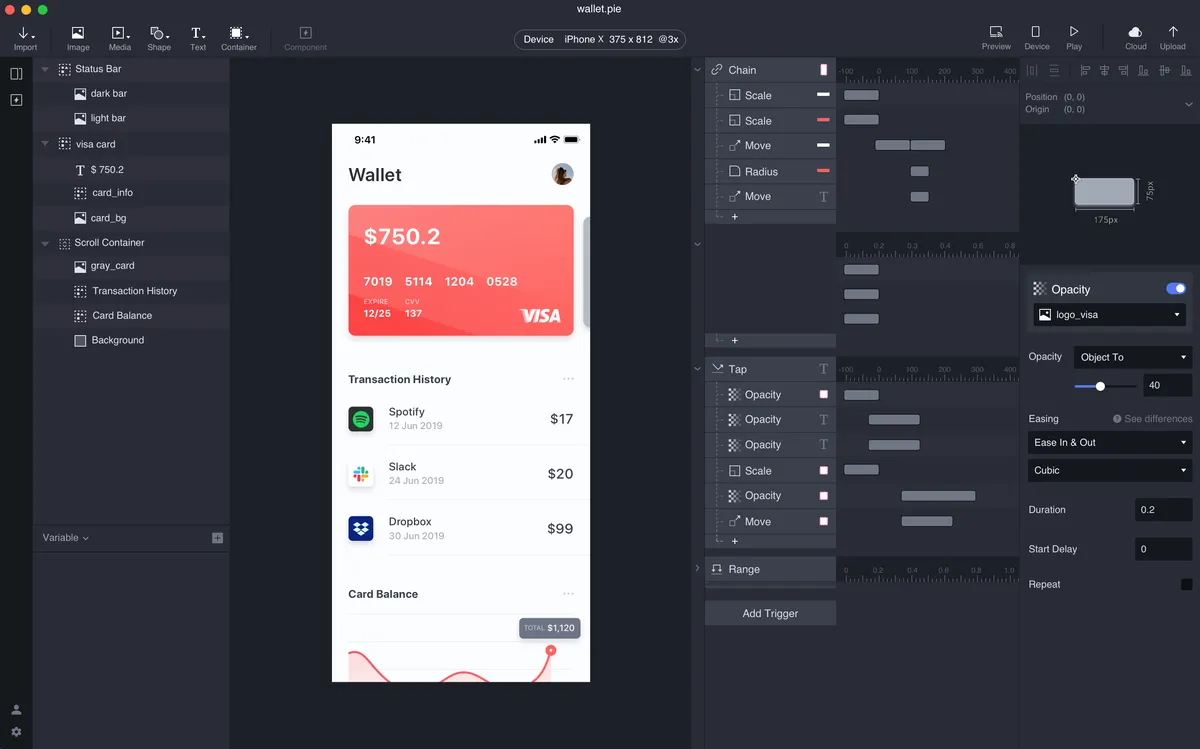
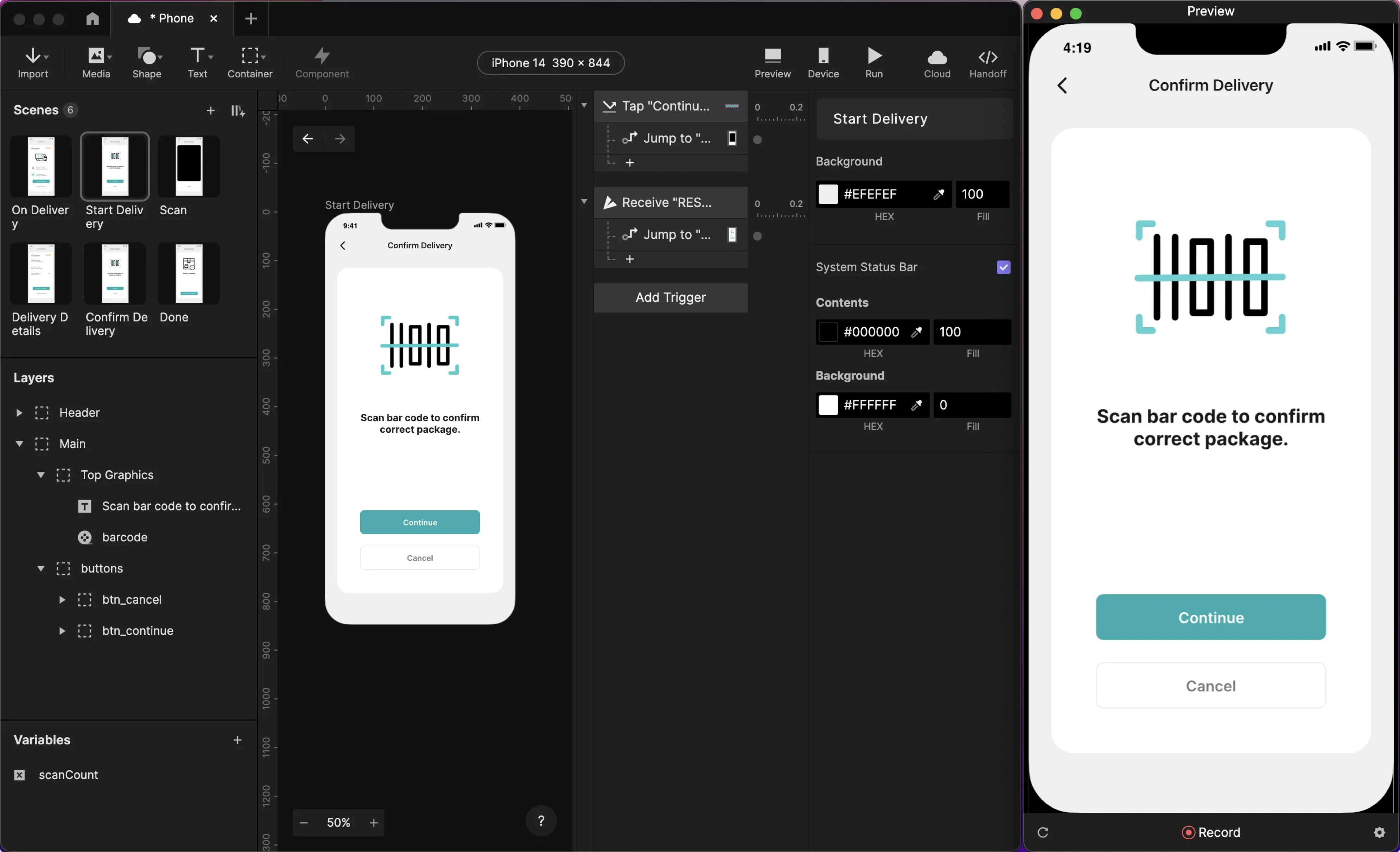
Then, ProtoPie offers a highly flexible system of triggers and responses that gives complete control over the prototype's behavior. This modularity makes it easy to create complex scenarios without resorting to code, via an intuitive interface based on precise conditions, variables and timing.
Advanced features include multi-device synchronization, enabling a prototype to be tested on multiple screens at the same time to verify cross-device interaction. This is a major asset for mobile or IoT projects.
ProtoPie also supports advanced integrations with other design tools such as Sketch, Figma or Adobe XD, facilitating design import and workflow continuity between design and prototyping.
ProtoPie shows its limitations mainly in certain specific use cases: it's not ideal for those looking for a fully collaborative real-time tool, nor for teams who want full integration into a software development ecosystem.
Alternatives such as Figma or Adobe XD offer better multi-user collaboration and more integrated workflows for design and prototyping. Nevertheless, ProtoPie retains the advantage when it comes to complex interactions and fine simulation, thanks in particular to its intuitive interface and advanced triggers.
In summary, ProtoPie's advantages lie in its ability to create highly realistic and detailed prototypes, but you'll have to accept a few compromises on team collaboration and software integration compared with some competitors. If these points are key for you, it's worth comparing before deciding.
FAQS
Is it reliable and secure?
ProtoPie is a desktop application that does not rely on the cloud for the creation part, thus guaranteeing data confidentiality. For security, the tool offers regular updates and a strict policy on the handling of user data. Prototype files are stored locally, limiting the risk of leakage.
For mobile testing, exchanges are encrypted and secure. ProtoPie is recognized as reliable for professional use where confidentiality and robustness are required, particularly in companies working on sensitive products.
Is it compatible with my other tools?
ProtoPie is compatible with macOS and Windows. Prototypes can be tested on iOS and Android via a dedicated ProtoPie Player app. For integration into workflows, it supports embedded import from Sketch, Figma and Adobe XD, facilitating the transition from design to prototype without loss of quality.
The tool also offers an API to automate certain processes and extend functionality according to the specific needs of your project.
Is there responsive customer support?
ProtoPie customer support is accessible via email and chat, with generally fast response times, especially for users of paid packages. Documentation is comprehensive and well-structured, offering tutorials and FAQs to quickly resolve common problems.
A forum and active community complete the ecosystem, offering users direct exchange with experts and other prototyping professionals.
What do other users think?
User reviews are generally very positive about ProtoPie. They emphasize its power to create highly realistic prototypes and its quick learning curve despite its rich functionality. Users particularly appreciate the precision of possible interactions and the flexibility of scenarios.
Some negative feedback concerns the cost of the full version and team collaboration that could be improved, especially in the context of agencies with several contributors.
Can I easily change later?
User reviews are generally very positive about ProtoPie. They emphasize its power to create highly realistic prototypes and its quick learning curve despite its rich functionality. Users particularly appreciate the precision of possible interactions and the flexibility of scenarios.
Some negative feedback concerns the cost of the full version and team collaboration that could be improved, especially in the context of agencies with several contributors.
Alternatives

Specializing in business creation, sales and digital marketing, he puts his expertise at the service of users to help them identify the solutions best suited to their needs. Passionate about digital innovation and optimizing online performance, Alexis is committed to providing detailed, transparent and unbiased comparisons.
Do you have an entrepreneurial project?
We support you in the structuring and development of your tech project. Make an appointment with one of our Business Strategists.