.avif)





.svg)



Table of Contents



Published on
5/3/26
-
5 min
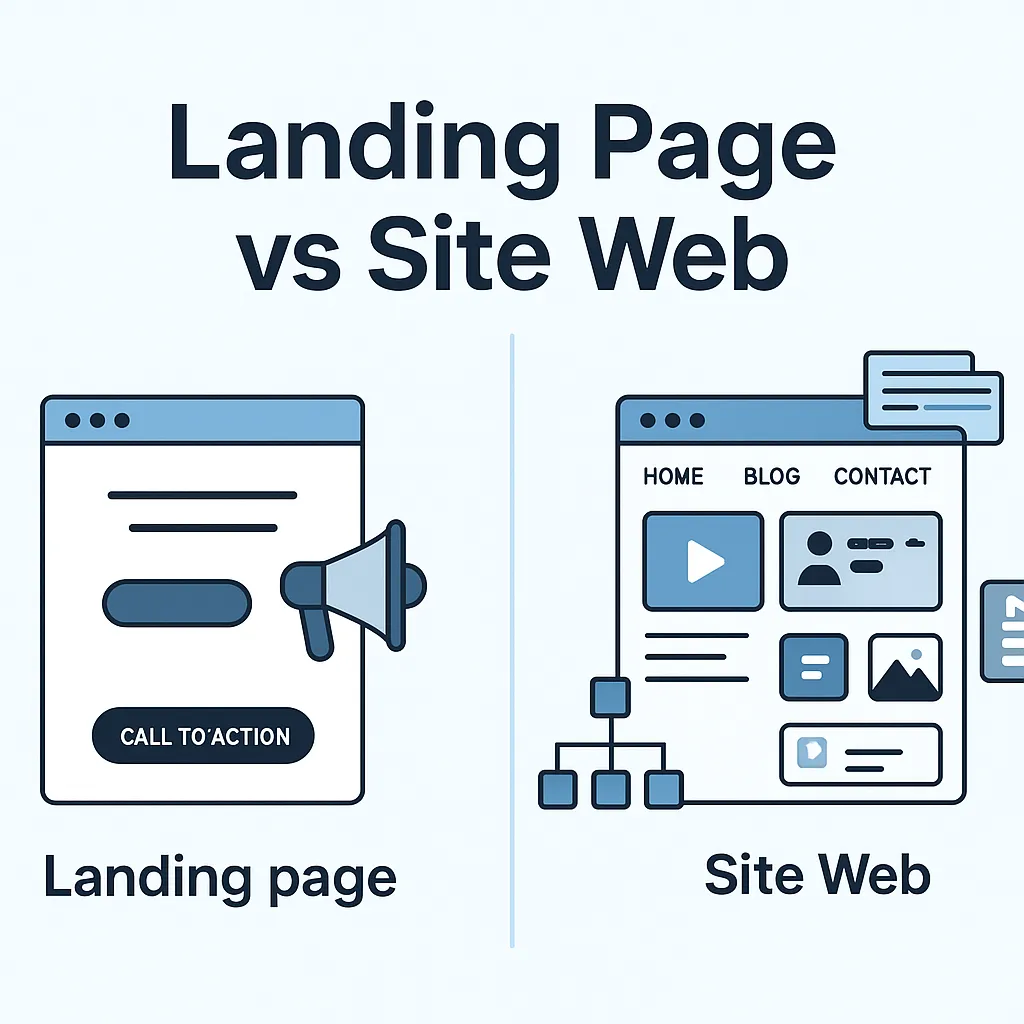
Before deciding between a landing page and a full website, make sure you understand their respective roles. You can read our introductory article What is a landing page? Definition, objectives, and tips to lay the groundwork. This guide will help you choose the best solution for your marketing needs, budget, and acquisition goals.
In this video, we'll compare the two so you can understand their strengths, limitations, and, most importantly, when to choose one over the other.
There's nothing clearer than an explanatory video to understand in depth what a landing page is. Instead of settling for a theoretical definition, a visual demonstration allows you to see concretely how it looks, what elements it consists of, and how each one plays a role in conversion.
A landing page is a standalone page designed for a specific action. It targets a specific segment of your audience with a clear message and a well-defined conversion goal: capturing emails, downloads, registrations, or purchases. Its effectiveness lies in its simplicity, speed of deployment, and single focus.
It is ideal if you are launching a marketing campaign, testing a new product, or want to validate market interest without creating an entire website. The cost is low, creation is quick, and results are measurable.
A complete website is your brand's digital showcase. It includes several pages (home, about, services, blog, contact, etc.) and allows you to structure a richer user experience. It is essential if you are developing a content strategy, working on your SEO, or want to present your entire offering in a sustainable way.
A complete website gives you more credibility, especially for prospects who want to know more about you before buying. It is also often more suitable if you are working with multiple targets or multiple offerings.
If your goal is to generate leads quickly from a campaign, a landing page is sufficient. However, if you want to build a long-term strategy, your own website becomes necessary.
Creating a landing page takes less time and costs less than a complete website. It is perfect for quick tests and iterations. A complete website requires more thought, tree structure, design, development, etc., but it is a long-term investment.
A complete website is an essential tool if you rely on search engines, SEO, blogging, or recurring campaigns. On the other hand, a landing page may be sufficient if you mainly use paid advertising, social media, or targeted email campaigns.
It is entirely possible to integrate landing pages into a comprehensive website. This hybrid strategy is actually the most effective. The website serves as a credible and referenced base, while the landing pages focus on specific conversions.
The choice between a landing page and a full website depends on your digital maturity, your marketing objectives, and the time you are willing to invest. If you are just starting out or testing an offer, start with a landing page. If you are in a growth or structuring phase, go for a full website—and integrate dedicated conversion pages into it.
To take your performance optimization further, continue reading with these articles: