.avif)




.svg)


Table of Contents



Published on
31/8/26
-
5 min

Finding an agency in France capable of developing an iOS and Android mobile app with Flutter is harder than it seems. Not because there is a shortage of providers, but because most pages found online repeat the same marketing promises ("single codebase," "cost reduction") without ever providing the evidence, technical criteria, or real budget ranges needed to make an informed decision.
This guide is designed for executives, CTOs, and digital managers who want to look beyond the slogans. Here are 7 concrete criteria for identifying the right Flutter iOS/Android agency in France, including what to ask, what it costs, and how Easyweb approaches these topics in practice.
Yes, and here is how.
An agency that "does Flutter" and an agency that delivers production-ready apps for businesses are not the same thing. Before signing anything, check if the team can precisely answer these four questions:
If the agency answers vaguely or refers you to general documentation, that is a red flag. Easyweb systematically documents the chosen architecture from the scoping phase, with justifications based on the app's profile.
For a mobile app intended for a business, Flutter development is only the tip of the iceberg. The bulk of the technical risk lies in integrations: REST or GraphQL APIs, OAuth 2.0/OIDC authentication, enterprise SSO (Okta, Azure AD), CRM/ERP connectors, or offline/online synchronization. Ask these questions directly:
Agencies that have never managed these issues in a B2B context tend to underestimate integration timelines and costs, which leads to project drift. This is often where the most common 30% to 40% budget overruns occur.
Almost, and the difference doesn't matter for 95% of projects.
Flutter isn't native in the strict sense (Swift/Kotlin), but it compiles to native machine code via the Skia/Impeller engine and accesses OS features through plugins. For almost all enterprise projects, the difference in perceived performance is negligible.
Pure native (Swift for iOS, Kotlin for Android) remains preferable in very specific cases: low-level Bluetooth access, advanced AR/VR, real-time video processing, or highly specific hardware dependencies. Outside of these cases, Flutter offers high-performance UI on iOS and Android with a single codebase, making it the standard for business mobile applications, fintech, healthcare, and industrial apps that need to move fast without sacrificing interface quality.
Many agencies avoid this comparison. Here are the real facts:
Flutter is the best choice for an MVP, a complex business app, or a need for cross-platform UI consistency. Pure native remains relevant only if your app relies heavily on very recent system APIs or specific hardware.
Ranges vary significantly depending on the functional scope:
The factors that most influence the price are: UI complexity and design system, the number of IS integrations, offline or real-time data management, security requirements (obfuscation, secret management, GDPR), and the level of test coverage.
Key takeaway : Failing to include maintenance in your TCO is the most common mistake. Flutter/Dart updates (major versions roughly every 6 months), increasing App Store and Google Play requirements, and security patches represent a real workload. Budget for about 20% of the initial development cost per year—for example, €10,000/year for an app developed for €50,000.
Several French agencies specialize in developing Flutter iOS/Android mobile applications for businesses. Here is an overview of the profiles available on the market.
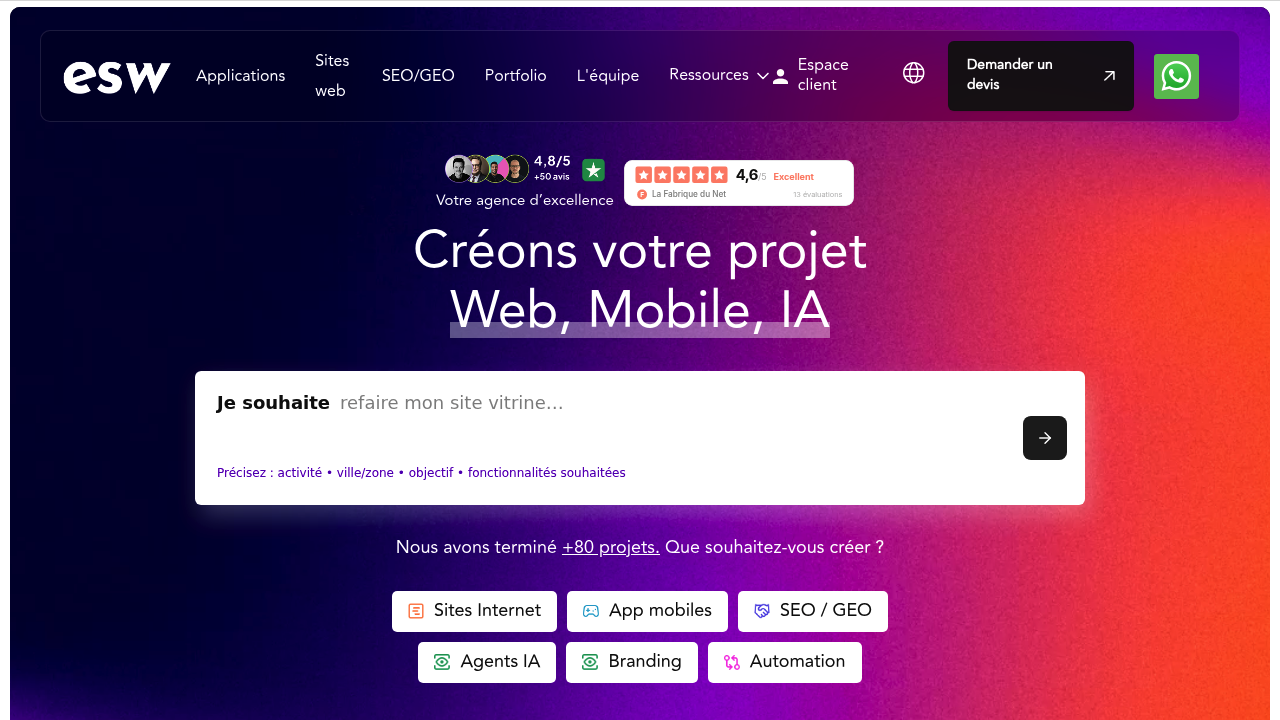
A French full-service agency specializing in the design and development of custom digital products. Easyweb handles the entire project lifecycle in-house: product scoping, UX/UI, Flutter iOS/Android development, IS integrations (API, auth, CRM/ERP), CI/CD, store launches, and ongoing maintenance and roadmap management. Their approach relies on reusable modules and AI tools to reduce lead times and optimize costs without compromising technical quality. This is the preferred option for companies seeking a single partner from concept to deployment, with genuine transparency regarding costs and technical trade-offs.
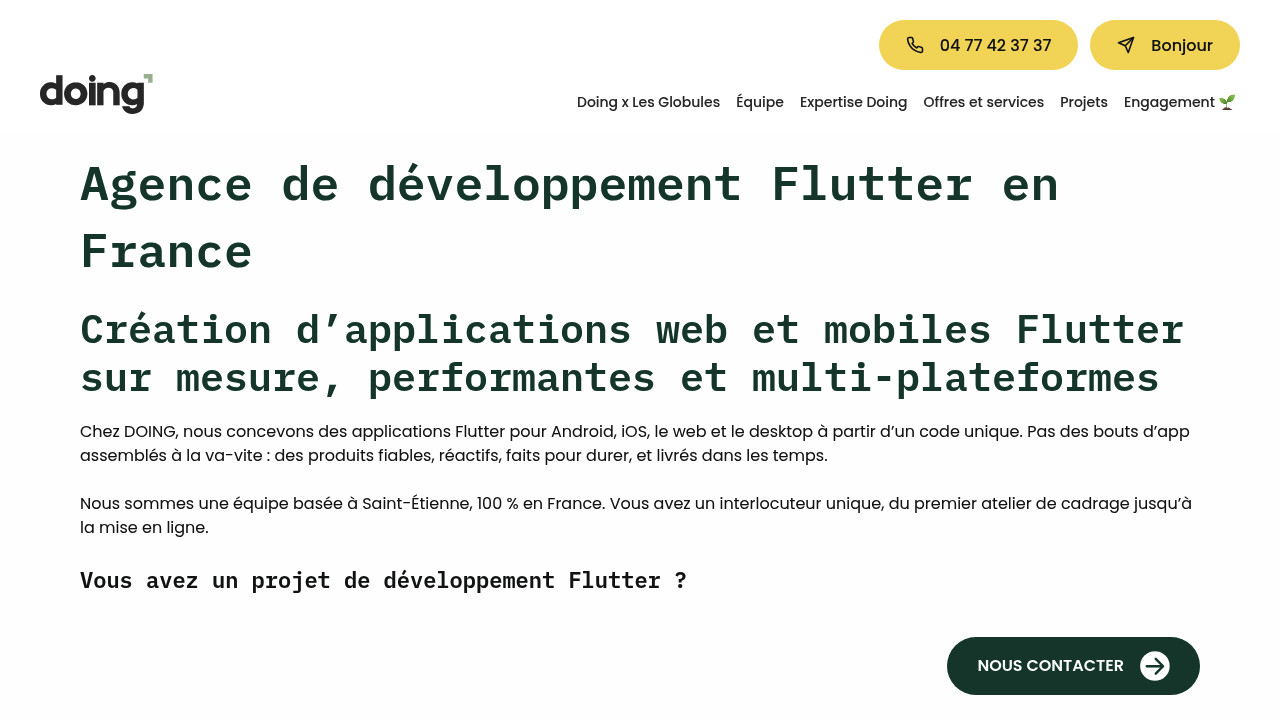
A Paris-based agency with a clear value proposition centered on a single Flutter codebase to reduce costs and accelerate time-to-market. They have a solid presentation structure and local credibility signals. The content lacks quantitative evidence and technical depth, making it difficult for a technical buyer to compare.
Explicitly positioned for end-to-end Flutter development, from UX design to iOS/Android deployment. The promise is consistent, but the content remains generic regarding technical differentiation. There are few decision-making tools (no comparisons, no public budget ranges).
Interesting focus on B2B mid-market cases with mentions of offline-first capabilities and IS integrations. Portfolio and experience are visible. Like most players, their promises of cost reduction are not supported by measurable client metrics.
Fairly comprehensive coverage of the Flutter topic, including a "when to choose / when to avoid" section and an objection-oriented FAQ. Client logos are visible. The text-heavy format and lack of case studies with metrics make the decision process more difficult for a buyer looking for concrete proof.
Here is a practical checklist to use during interviews. A serious agency will answer these questions with precision and concrete examples. If the response revolves around "it depends on the project" without further elaboration, it indicates a lack of structured processes.
Yes. Flutter is used in production across all three sectors. Regulatory constraints (GDPR, HDS for healthcare, fintech compliance) are handled at the architecture and integration level, not by the framework itself. Easyweb supports projects in these sectors with a scoping approach that integrates these constraints from the definition phase, before a single line of code is written.
Between 2 and 4 months for a reasonable scope (authentication, 3 to 5 business screens, one API integration). This timeline can be reduced if the agency has reusable modules. Easyweb leverages proven technical building blocks to reduce time-to-market without compromising quality.
Plan for approximately 20% of the initial development budget per year. For a €50,000 app, this represents €10,000/year to cover OS updates, Flutter/Dart evolutions, store requirements, and security patches. This is a line item that should be included in the TCO from the scoping stage.
Through solutions like Drift (SQLite), Hive, or Isar for local storage, paired with backend-side synchronization logic. Conflict management must be planned during the scoping phase, not added along the way. This is one of the points the Easyweb team systematically addresses during the first technical discussion.
The majority of plugins you need (camera, Bluetooth, push notifications, biometrics, maps) are available on pub.dev with a high level of maturity. For highly specific requirements, it is possible to write a custom native plugin (Swift/Kotlin) that integrates into the Flutter app without compromising the rest of the codebase.
This is a key question that is often overlooked. Flutter releases a major version approximately every 6 to 9 months. A reputable agency documents dependencies, keeps versions up to date, and includes a migration budget in the maintenance contract. Ask for this in writing before signing.
Do you have aniOS and Android mobile app project? Talk to the Easyweb team for a quick scoping session: the type of app, estimated budget, and timeline are enough to get an initial technical and budgetary assessment with no obligation.