.avif)





.svg)



Table of Contents



Published on
5/3/26
-
5 min

SEO is not just about climbing organic rankings. For businesses, it is an operational lever capable of generating leads, improving conversion, and optimizing acquisition costs. Treating SEO as a simple marketing channel means underutilizing its real value: good positioning without the right architecture or relevant content will produce few measurable business gains. This article examines how to translate visibility into concrete opportunities by addressing the technical and editorial choices that determine performance.
We will begin by explaining why SEO should be thought of as a business lever, then we will detail the importance of SEO architecture, navigation depth, URL structure, facet management, and internal linking, before discussing the role of blogs and evergreen content in positioning. The goal is practical: to provide benchmarks for prioritizing actions and investments so that organic traffic becomes a stable source of commercial value. And if you're looking for an SEO agency, our experts are here for you.
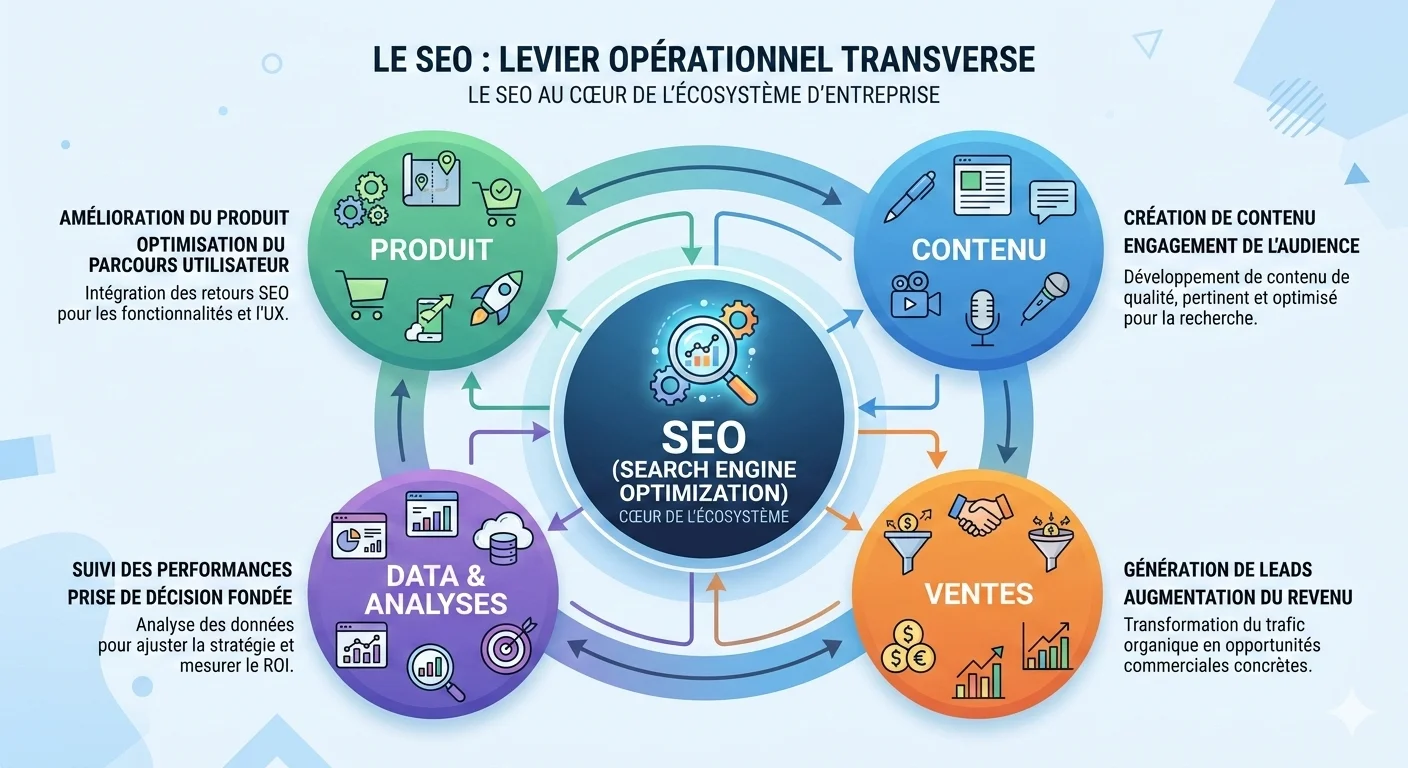
Business SEO integrates organic visibility into the commercial strategy. Rather than focusing solely on traffic volumes, it is necessary to identify the pages that contribute to revenue, registrations, or lead qualification. This involves linking SEO objectives to business metrics through conversion tracking, multi-touch attribution, and customer journey analysis. For example, a well-positioned guide page on an informational query can generate leads if it has a relevant CTA and an appropriate funnel.
Thinking of SEO as a lever also means prioritizing keywords according to their commercial value and feasibility. Transactional queries and those close to purchase intent often deserve more resources than generic queries with low conversion rates. Finally, the internal organization must reflect this logic: SEO, content, and product teams collaborate to transform visibility into real opportunities, with shared KPIs and regular performance reviews.
A solid SEO architecture determines a site's ability to capture and convert organic traffic. It defines how pages are accessible, indexed, and linked to each other, and directly influences the relevance perceived by search engines and the user experience. Without a consistent architecture, even quality content will struggle to reach its target audience and generate lasting business benefits.
Thinking about SEO architecture is not just about optimizing tags and sitemaps. It's about designing logical paths for users and indexing robots, reducing friction between discovery and conversion, and anticipating site developments (product catalog, filters, new sections). Decisions about navigation depth, URL structure, facet management, and internal linking are concrete levers: when executed well, they increase the efficiency of editorial and technical efforts.
Navigation depth is the number of clicks needed to reach a page from the home page or a category page. Excessive depth penalizes indexing and reduces the chances of conversion, as users are more likely to abandon the site. In practice, aiming for a maximum depth of 3 clicks for strategic pages helps maintain a strong signal for search engines and a smooth journey for visitors.
On large sites, the solution combines logical organization and the creation of pivot pages. For example, structuring "hub" pages that group related topics reduces depth while providing optimized entry points for business SEO. It is also relevant to monitor server logs to understand the frequency of robot exploration and prioritize crawling on high-value pages.
URL structure affects readability, sharing, and indexing. Short, hierarchical, and stable URLs make it easier to find important pages. For an e-commerce site, a consistent structure for categories and subcategories limits SEO dilution and clarifies the intent of the pages. Avoiding unnecessary parameters and standardizing nomenclature reduces the risk of duplication.
Facet management is one of the frequent challenges: filters often produce a multitude of similar URLs that hinder indexing and disperse authority. Possible strategies include limiting the indexing of filtered pages via noindex/canonical, using settings in Google Search Console to ignore certain parameters, or generating explicitly useful and unique filtered pages optimized for specific queries. The choice depends on the size of the catalog and the commercial value of the facet variations.
Internal linking distributes authority between pages and guides both robots and users to the most important content. Good internal linking organization allows you to highlight commercial or high-conversion pages from informational content or thematic hubs. For example, a blog post optimized for a search intent can point to a product page or landing page with contextualized anchors, improving both SEO and the funnel. Operational
principles include: limiting unnecessary links on a page, using descriptive anchors, and creating logical paths between complementary content. Regular link audits reveal isolated or overloaded pages and allow authority to be rebalanced. Internal linking is particularly effective when integrated into the editorial roadmap, prioritizing links from evergreen content to business-critical pages.
SEO blogs and evergreen content are drivers of sustainable traffic and qualification tools. Evergreen content responds to stable queries and generates a constant flow of visitors, while blogs capture trend signals and support pillar pages with internal links. Their impact on positioning is measured not only in visits, but also in assisted conversions and brand awareness.

To maximize the effect, evergreen content production must be aligned with keyword strategy and business objectives. A well-optimized guide article can attract searches at the top of the funnel and, thanks to structured internal linking, pave the way for transactional pages. The key lies in prioritization: produce less but better, regularly update high-performing content, and provide appropriate CTAs to convert traffic into measurable opportunities.
In the rest of this article, we will analyze concrete methods for evaluating SEO performance through a business lens and tactics for converting organic traffic into commercial value. +
An international presence requires more than just literal translation of pages. It involves aligning the experience, content, and technical signals in distinct markets to capture relevant local intent. Hreflang markup plays a central role in telling search engines which language or geographic version to present to users, but it is only one element of a broader SEO internationalization strategy.
Strategically, the choice of internationalization architecture affects SEO performance. Three models dominate: ccTLDs (country by domain), subdomains, and subfolders. ccTLDs offer a strong geographic signal, useful when the brand needs to position itself locally in an independent manner. Subfolders simplify authority consolidation and reduce operational complexity, often preferred for multi-market sites seeking efficiency and scalability. Regardless of the model chosen, signal consistency must be ensured: correctly implemented hreflang, relevant canonical tags, and sitemap management for each language version.
Technically, common hreflang errors do more harm than good: missing or non-reciprocal tags, incorrect language/country code, lack of an x-default for non-targeted users, or conflict with canonicalization. Regular audits via logs, Google Search Console, and specialized crawlers can identify these issues. In terms of content, focusing on complete localization—adapting offers, currencies, units, and cultural examples—improves conversion rates. Finally, measurement must be segmented by language and country: tracking conversion metrics, revenue per visit, and acquisition cost per market allows you to adjust your internationalization efforts based on actual ROI.
SEO scalability relies on the ability to transform organic gains into recurring economic growth without proportionally increasing costs. This involves three levers: industrialization of high-value content, technical automation, and data-driven governance.
Industrialization does not mean mass production without control. It means identifying reproducible formats that perform well—enriched category pages, standardized product sheets, local guides—and then designing robust SEO templates that integrate tags, structured data, and unique editorial content areas. Programmatic pages can cover thousands of relevant variations if they comply with quality rules and avoid duplication. For a marketplace, for example, automatically generating pages targeted to product-location combinations can generate a significant flow of qualified traffic if each page provides unique value to the visitor.
On a technical level, scalability requires a high-performance architecture: controlled loading times, server capacity, cache management, and error monitoring. An unexpected organic spike can harm the experience and ruin the SEO effect. Similarly, the roadmap must include safeguards against the proliferation of unwanted URLs—canonical strategies, indexing rules, and search console settings—to preserve SEO juice.
Governance and measurement are crucial. Defining OKRs that link organic traffic to business results—organic revenue, assisted conversions, LTV per channel—helps arbitrate investments. Incrementality testing and cohort analysis provide insight into the real impact of SEO pages and help prioritize optimizations. Finally, to scale effectively, institutionalizing processes—templates, localization guidelines, technical checklists for deployments—ensures that quality remains consistent as volume grows.
For an SEO investment to become a sustainable growth driver, it must be designed as a cross-functional platform that aligns product, content, and data. Organic visibility must be part of reproducible systems—URL architectures, editorial playbooks, technical templates—and measurement loops that link positions and pages to concrete business results. Multilingual SEO and hreflang illustrate the importance of fine coordination between technology and content when a company expands internationally. Scalability, on the other hand, requires automating repeatable gains while maintaining quality criteria and impact analysis mechanisms.
Rather than treating SEO as a series of isolated actions, it must be integrated into the product roadmap, associated with business KPIs, and governed in a way that ensures overall consistency. This approach transforms SEO efforts into reusable assets: every optimized page, every deployed workflow, and every data-driven decision contributes to a platform capable of capturing and converting organic traffic on a large scale. In the medium term, true performance is measured less by one-off rankings and more by the system's ability to generate repeatable and measurable business opportunities across all target markets.
Continue reading:
-
How to optimize your content to be cited by AI?
- How to choose your agency and budget for a website redesign?