.avif)





.svg)
.svg)



Table of Contents


Published on
5/3/26
-
5 min

AI agents are becoming increasingly central to discussions about artificial intelligence. The term is widely used, sometimes incorrectly, to refer to very different realities. This confusion makes it difficult for both decision-makers and operational teams to understand what the concept of an AI agent actually encompasses.
This article is part of a broader series of content devoted to artificial intelligence and AI agents, the aim of which is to establish a clear and lasting foundation. Its purpose is to provide a stable, explanatory, and reusable definition, without going into technical considerations or implementation cases. It serves as a conceptual reference that subsequent articles in the cocoon can draw on to explore the uses, limitations, and implementation methods in greater depth.
An AI agent is a system capable of acting autonomously based on a given objective, taking into account a context and adjusting its actions according to the results obtained. This definition emphasizes three fundamental elements: the existence of an objective, the ability to perceive an environment, and autonomy in decision-making.
Unlike a simple execution of fixed rules, an AI agent does not simply apply predetermined instructions. It interprets a situation, chooses one action from several possibilities, and adapts its behavior when the context changes. This ability to adapt is at the very heart of the concept of an agent.
An AI agent is therefore not defined by the technology it uses, but by how it operates. It is a functional and logical concept, rather than a technical object. This approach clearly distinguishes AI agents from other automated systems that are often confused with them.
Several characteristics make it possible to reliably identify an AI agent. The first is autonomy. An AI agent can operate without constant human intervention once its objective has been defined. It does not wait for an action to be explicitly requested at each stage.
The second characteristic is the ability to interpret context. An AI agent perceives information from its environment, whether it be data, signals, or events. This perception allows it to understand the situation in which it operates.
The third characteristic is decision-making. The agent chooses its actions based on its objective and its perception of the context. It does not follow a single, predefined path. It evaluates different possible options.
Finally, an AI agent is capable of adaptation. It adjusts its decisions based on the results of its previous actions. This adjustment loop distinguishes the agent from a simple reactive system.

The functioning of an AI agent always begins with a goal. This goal may be explicit or implicit, simple or complex, but it structures the agent's entire behavior. Without a goal, there is no agent, only a passive system.
The objective serves as a reference for evaluating the decisions made. It allows the agent to determine whether an action is moving in the right direction or not. This orientation logic distinguishes the AI agent from a purely reactive system that would simply respond to stimuli.
An important point is that the objective does not necessarily imply a single purpose. It can be broken down into sub-objectives, priorities, or constraints. The agent must then arbitrate between different possible options.
To act appropriately, an AI agent must perceive its environment. This perception corresponds to all the information it is capable of capturing and interpreting. This may include structured data, signals, text, or events.
Perception is not just about receiving information. It involves a minimum interpretation of the context. The agent must be able to understand what this information means in relation to its objective.
This step is crucial because it determines the quality of future decisions. Partial or biased perception leads to less relevant choices, even if the decision-making mechanism is robust.
Based on the objective and perception of the context, the AI agent enters a decision-making phase. It evaluates different possible actions and chooses the one that seems most appropriate to achieve its objective.
This decision is not necessarily optimal in an absolute sense. It is based on an estimate, an interpretation of the context, and internal rules. What matters is the ability to choose from several options, not the perfect accuracy of the choice.
The decision may be simple or complex depending on the agent's level of autonomy. In any case, it is a central element of its functioning.
To clarify the differences, a comparative table provides clear benchmarks.
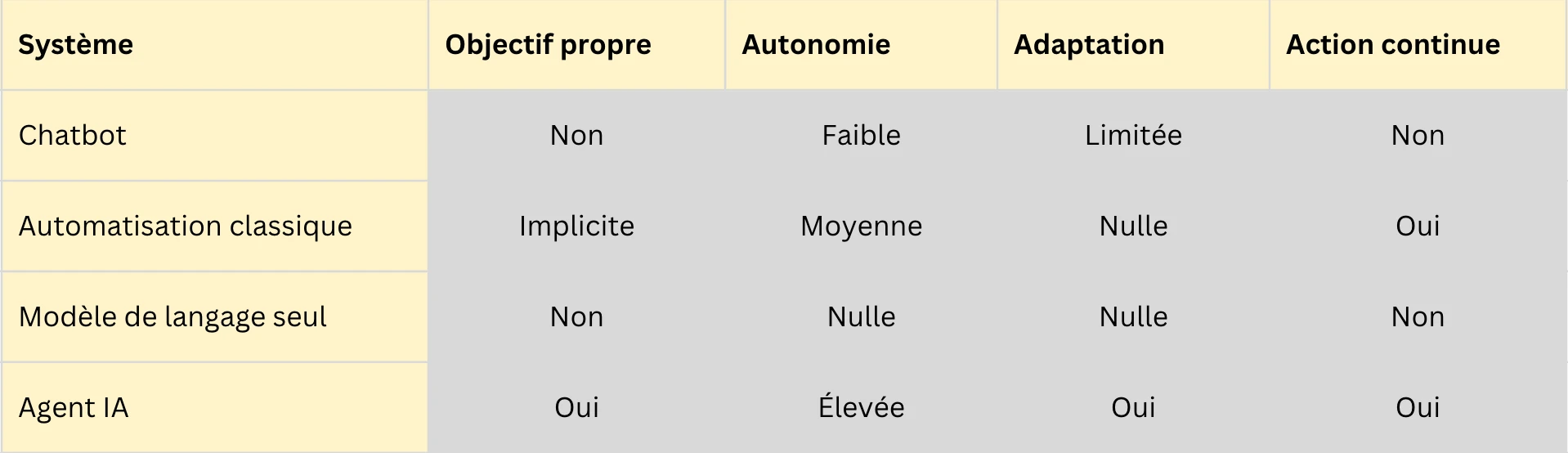
This table highlights the key point. The AI agent combines autonomy, purpose, and adaptability, whereas other systems only possess some of these qualities.
A chatbot responds to a specific request. It does not act over time and does not pursue an autonomous objective.
An AI agent, on the other hand, acts proactively and continuously.
Automation applies fixed rules. It works well in stable contexts.
An AI agent arbitrates and adjusts its actions when the context changes.
An AI agent can be tasked with coordinating a series of interdependent tasks. It plans actions, adjusts the order of execution, and reacts to unforeseen events.
In this type of scenario, the agent does not simply execute a predefined sequence. It adapts its behavior based on progress and constraints encountered. This ability to manage complexity distinguishes the AI agent from simple automation.
AI agents respond to a profound evolution in the use of digital technology. Organizations are seeking to delegate not only repetitive tasks, but also structured cognitive tasks. AI agents enable this delegation in a gradual and controlled manner.
Their value lies less in technical performance than in the cognitive gains they bring. By taking charge of certain decisions or coordination tasks, they free up time and attention for activities with greater human value.
Finally, AI agents fit naturally into complex and evolving environments. Their ability to interpret context and adapt makes them particularly well-suited to the contemporary needs of organizations.
An AI agent can be tasked with monitoring a set of information sources, identifying relevant items, and organizing them according to defined criteria. It acts autonomously, without continuous human intervention.
It perceives new information, assesses its relevance to its objective, and decides whether to classify, summarize, or flag it. Its role is not to produce a single response, but to maintain a coherent organization of information over time.
An AI agent can assist an organization in decision-making by analyzing a context, evaluating different options, and proposing directions. It does not replace human decision-making, but it structures the analysis.
It acts continuously, integrating new data and adjusting its recommendations. Its value lies in its ability to maintain an overview and reduce the cognitive load associated with complex decisions.
An AI agent can be defined as a system capable of acting autonomously based on an objective, perceiving a context, making decisions, and adapting its actions over time. This definition clearly distinguishes AI agents from simple automations, chatbots, or artificial intelligence systems used in isolation. It provides an essential conceptual basis for understanding their growing role in organizations and digital projects.
To deepen this understanding and move on to more operational levels, the following articles are a natural extension of this reading:
These articles explore the practicalities of implementation and the choices available in different contexts, without revisiting the fundamentals set out in this article.