.avif)





.svg)



Table of Contents


Published on
5/3/26
-
5 min
Developing custom SaaS software is a complex and strategic process that mobilizes technical, human, and functional resources at the heart of a company's digital transformation. Much more than just a simple IT tool, SaaS software designed specifically for your business must meet high standards in terms of customer relationship management, productivity, security, and business performance. Before even discussing budgets, it is crucial to understand the variables that strongly influence the final price. Every management software program, whether it is an ERP, CRM, or collaborative tool, is based on trade-offs related to the modules to be developed, customized features, the degree of integration into your existing information system, and the nature of your internal management processes.
The choice of a specific development, often led by an integrator or a specialized agency, also involves issues of licensing, maintenance, cloud hosting, deployment, and interfacing with other software solutions or management software packages already in place. If you haven't already done so, we strongly recommend that you read our article How much will it cost to develop a custom SaaS solution in 2025? to get a clear idea of the order of magnitude involved. This new article will help you understand the real factors that affect the cost of a SaaS project: the nature of the software, the complexity of the configuration, the development schedule, the number of end users, and adaptability to future developments.
A SaaS project becomes more expensive as it incorporates more management modules: CRM, billing, inventory management, analytical dashboards, task automation, and accounting management. Each business function (sales management, purchasing management, commercial management, supply chain) requires specific developments, sometimes integrated into an integrated management software package (ERP). The goal is to offer a software solution that precisely meets your business processes, with a customizable management tool tailored to your commercial activity.
The choice between cloud hosting (such as AWS, Azure, or a private data center), a SaaS model, or an open-source ERP (such as Dolibarr or Odoo) has a significant impact on the final cost. Multi-tenant architectures, license management, and security requirements (GDPR, backups, logs, traceability) also influence the cost of implementation and hosting. A hosted solution with automatic backups, active monitoring, and software module integration quickly becomes more expensive... but also more robust.
A serious project requires a multidisciplinary team: developers, UX designers, integrators, functional consultants, ERP project managers, QA, and DevOps. Depending on whether the team is based in France or outsourced, hourly costs can double. In addition, DevOps cycles, the implementation of collaborative workflows, and customer support requirements (24/7 or not) have a significant impact on the bill.
The agile approach with sprints, backlogs, acceptance tests, and iterative reviews provides a better user experience, but requires more time for project management. It also requires advanced tools: project dashboards, monitoring indicators, resource management, collaborative management, and regular interactions with the IT department. Operational testing phases are necessary to ensure software quality and flexibility.
Connecting to software such as Sage, Cegid, Microsoft Dynamics, or even in-house CRM software requires the development of APIs or connectors. These software integrations are critical to ensuring data uniqueness, centralization, and process unification. The cost varies depending on the interfaces, data volume, and complexity of the synchronization rules.
Creating automation scenarios (e.g., automatic sending of emails, reminders, invoices, CRM synchronization, etc.) is useful for saving time, improving customer relations, and optimizing time management, but these developments require precise workflows, fine-tuning, unit testing, and a good knowledge of the applications.
A scalable management solution requires a maintenance budget: hotfixes, security patches, version upgrades, technical support. This is the natural life cycle of any enterprise software or management software package. The implementation of the software must include these costs to avoid unpleasant surprises.
A good software publisher often offers a monthly subscription that includes support, assistance, updates, and access to new features. This model, typical of SaaS, facilitates integrated management, improves the experience, and makes costs more predictable.
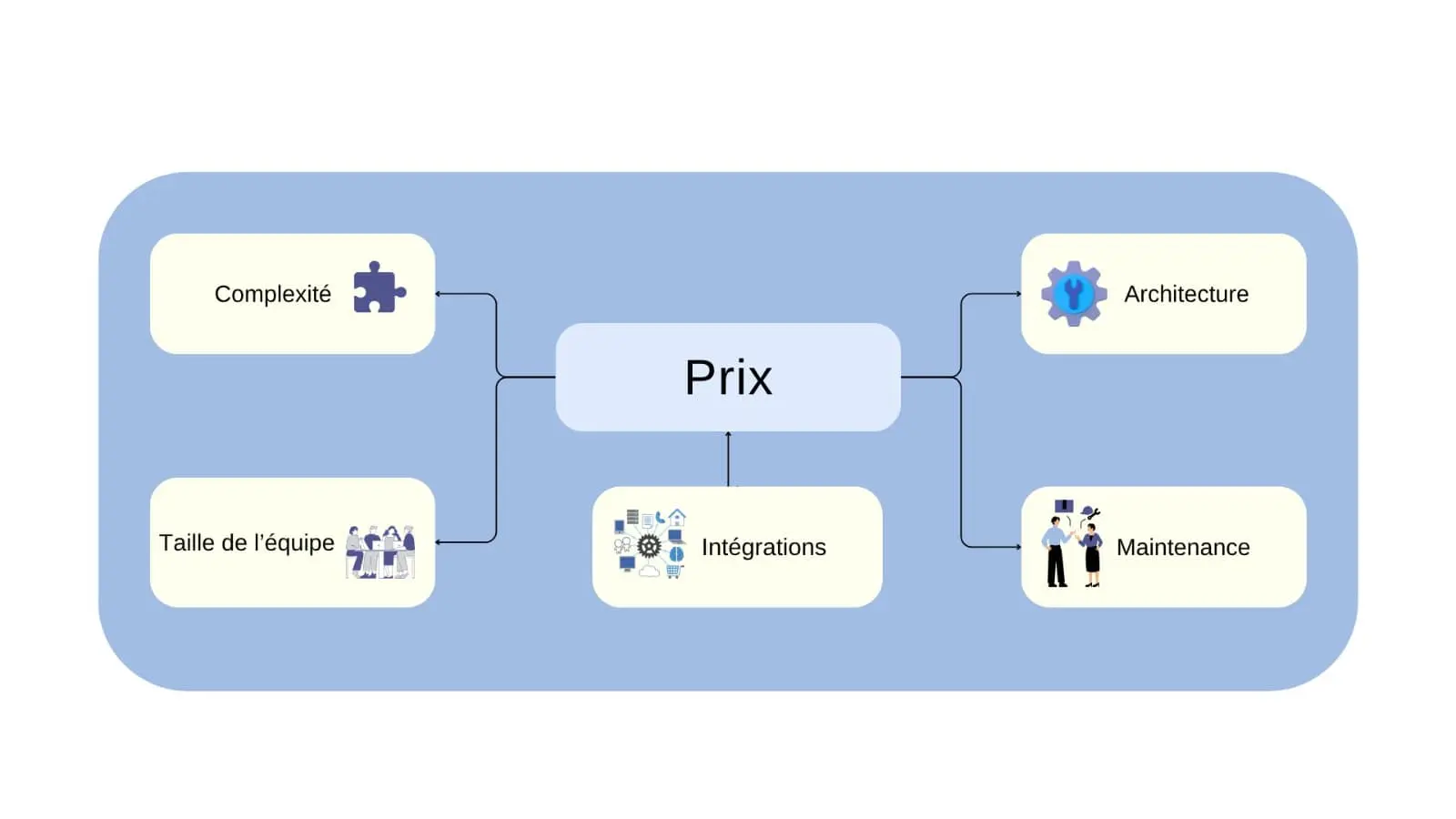
The main pricing criteria for a customized SaaS project are therefore:
A good customized management solution should be thought of as a comprehensive project: collaborative, managed, hosted in the cloud, with a real operational workflow adapted to your business environment. For a realistic estimate, refer to our reference article. To learn more, continue reading these two complementary articles: