.avif)





.svg)



Table of Contents


Published on
5/3/26
-
5 min
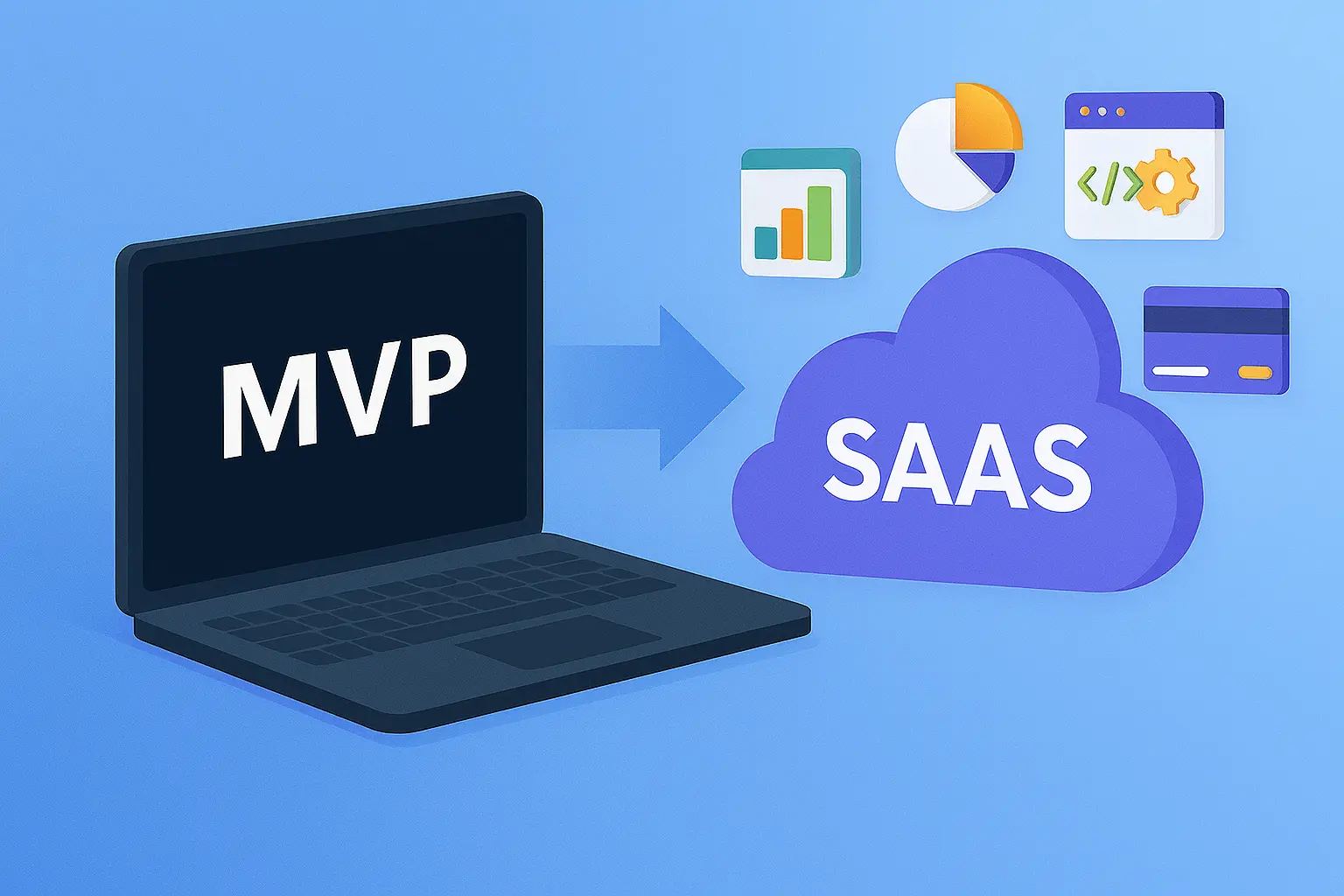
An MVP (Minimum Viable Product) is just a starting point in the creation of a software solution. It is a simplified version, designed to validate initial functional and technical assumptions at a controlled development cost. But to turn it into a true business management software, post-launch investments quickly become essential.
The evolution from an MVP to a complete SaaS involves much more than simply adding features. You need to think about customization, customer relationship management, integration with your information system, scaling, task automation, and data security. These are all critical steps in transforming a minimalist tool into an integrated management solution capable of supporting your business performance, productivity, and operational management challenges.
Before going into detail, we recommend that you consult our main guide, How much will it cost to develop a custom SaaS solution in 2025? to understand the budgetary orders of magnitude, possible business models (license, subscription, cloud hosting, etc.), and the key steps in professional software development.
Once the MVP has been validated by your first users, the priority is to add the missing management modules: billing, analytical dashboards, CRM, sales management, human resources management, and automated workflows. Each business module represents a functional upgrade, and therefore an increase in the budget.
Integrating these features requires specific developments to match your information system, key performance indicators (KPIs), business processes, and customization needs. The challenge is also to improve the user experience (UX) in order to reduce bounce rates, increase customer satisfaction, and boost conversions.
The evolution from an MVP to a high-performance SaaS platform requires a more robust technical environment: secure hosting (AWS, Azure), modular architecture, real-time monitoring, automated backups, and connection to relational databases (MySQL, PostgreSQL).
Strict requirements are emerging: GDPR compliance, access security, load management (number of users, bandwidth, data storage). Everything must be orchestrated within a scalable and collaborative software architecture, hosted in a private cloud or data center.
One of the most complex (and costly) aspects of SaaS evolution is the growing need for interoperability with other management software: ERP (Cegid, Dolibarr, Odoo), CRM (Salesforce, Microsoft Dynamics), e-commerce platforms, marketing automation tools, accounting or payroll management systems.
Each integration must be designed with robust APIs, authorization management, a logging system, and detailed traceability. This type of interfacing improves the customer experience, but also requires constant maintenance. 4. Maintenance, support, and governance
Maintaining high-performance SaaS software also means providing follow-up: customer support, bug fixes, version upgrades, and continuous improvement. A reputable publisher or integrator will offer maintenance contracts that include assistance, a roadmap for future developments, and product performance management.
Performance indicators must be tracked in a marketing dashboard: number of active users, transactional email open rates, return on investment, conversions, shopping cart abandonment, etc. These indicators make it possible to prioritize developments and justify allocated budgets.
An MVP is a starting point. But for it to become a truly structured, customizable SaaS software solution adapted to business process management, you need to plan for a development budget. Expect to spend between €15,000 and €150,000 to turn an MVP from a functional prototype into a complete management tool.
The main factors that will affect this budget are:
Be sure to discuss these points with your service provider to avoid tunnel vision and maximize the return on your software investment.
Other articles that may interest you: