.avif)





.svg)



Table of Contents


Published on
5/10/26
-
5 min
Are you scoping out an app project and want to build on a solid foundation? Discover our development offer formobile applications and how we build project specifications with our clients.
A project specification document is not just administrative red tape; it is a moral contract between you and the team that will build your product. It is the document that ensures the person coding, the person designing, and you are all talking about the same application. Without it, everyone proceeds with their own interpretation, and the discrepancies show up at the time of delivery. Here is how to write it, section by section.
Poorly defined requirements are one of the leading causes of software project failure. Standish Group reports (h) on tens of thousands of projects point out, year after year, that vague and incomplete requirements are a major factor in project abandonment or budget overruns. The project specification document is the exact tool that neutralizes this risk by transforming intentions into verifiable specifications.
Imagine three team members with three different ideas of what the application is. The project drifts before it has even begun. The project specifications lock in a shared vision that everyone can refer to in case of doubt. It also protects you legally: what is included is owed, and what is not included requires an amendment.
This document is part of a broader process, the sequence of which we described in our article on the seven stages of an application project. The project specifications are the second stage, the one that makes all subsequent stages quantifiable.
Before you start writing, formalize your needs. A project specification document doesn't invent anything; it gives shape to decisions that have already been made. For construction management software, for example, you need to know in advance which business functions to integrate, whether access to plans and quotes is required, if approval workflows are necessary, and if geolocation is involved.
This preliminary work builds on the definition of your personas, which we detail in our dedicated guide. Until you know exactly who it is for and what it is used for, the project specifications have nothing to formalize.
The first section introduces your company, your project, and the purpose of the application. This framework is structured around three questions: why this need exists, what solution the application provides, and how it integrates with your existing tools.
This context helps service providers understand your business before diving into your requirements. Don't hesitate to include diagrams: a visual of the architecture is worth ten lines of ambiguous explanation.
A project without measurable objectives cannot be evaluated. Define what the application should achieve: improving customer experience, optimizing internal processes, reaching a new market segment, reducing costs, or increasing visibility.
These objectives are not just for show. They determine the type of application to be built and which features to prioritize. An application focused on retention will not have the same scope as one focused on acquisition.
This section brings together your visual identity: colors, typography, logo, as well as your references and inspirations. The more precise you are here, the fewer costly revisions you will face during the design phase.
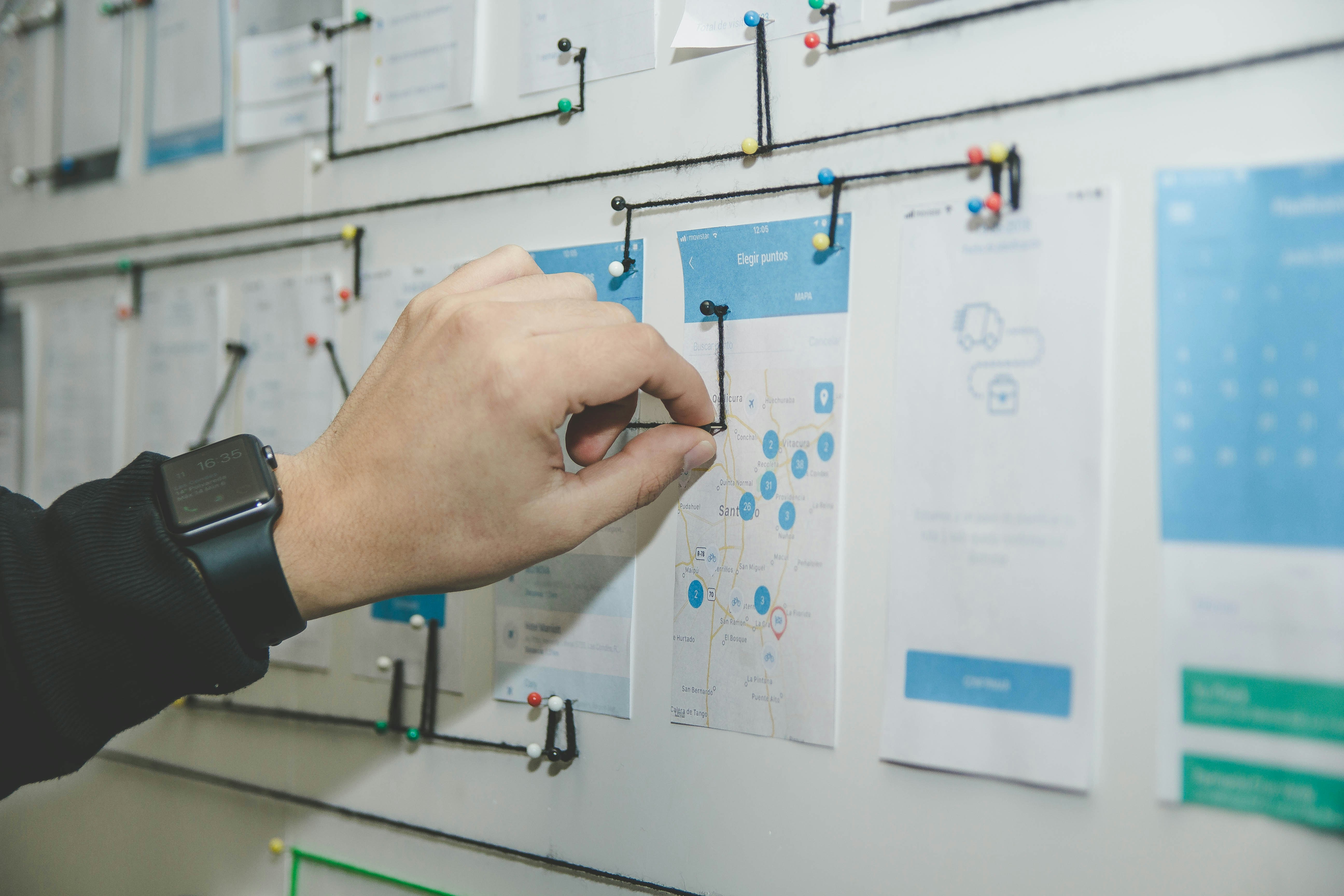
Prototyping happens in two stages. The wireframe outlines the user journey and site structure without focusing on style. The mockup, subsequently produced by the designer using a tool like Figma, brings this structure to life. The goal is to visualize the application's architecture and validate the user experience before development begins.
This is the realm ofUX design andUI design, which our UX/UI design team approaches in that order: the user journey first, the aesthetics second.
First, specify the type of application—such as a game, social network, utility, or collaborative platform—and the target platforms, whether iOS, Android, or tablet. This choice dictates a large portion of the technical decisions that follow.
The front-end is the visible part, the interface with which the user interacts. The specifications document must address the site map, interface, usability, and performance expectations. This is also where the question of native versus cross-platform developmentarises, a trade-off we have covered in detail in our comparison of iOS, Android, and cross-platform.
The back-end is the invisible, server-side component: data processing, business logic, and interfaces with other systems. The document must specify the key expected features, such as account management, notifications, connections to third-party services, as well as data storage and security via APIs.
List the tasks the application must be able to perform, from the most common to the most specific: advanced search, notifications, profile customization, geolocation, social sharing, and payments. This list is what makes your application unique, and it is what will be measured against the logic of the MVP to distinguish what goes into the launch from what will wait for a later version.
Poorly anticipated technical constraints lead to wasted time during the project. The specifications document must address several points.
Hosting, specifying whether you already have a provider or a preference. Application maintenance, designating who will handle it and at what cost, as an unmaintained application degrades with every system update. Store visibility, which involves ASO work that should not be confused with web SEO. Any necessary user training if the application is complex. And any additional features planned for later, which should be flagged from the start so that the architecture can accommodate them.
A service you intend to add six months after launch must be mentioned now. An architecture designed for a fixed scope can make future changes costly, or even impossible without starting over. The specifications document is where you define your desired future.
The final section sets the calendar. As a guide, prototyping takes one to two months depending on complexity, with a similar timeframe for the acceptance and user testing phase. Allow at least three months for an initial functional delivery on a small scope, and up to a year for a substantial application.
An honest schedule incorporates iterations between design, development, prototyping, and testing. These loops are not delays; they are the normal mechanism of a project that is adjusting. A calendar that ignores them is a calendar that will be wrong, and this budget deserves to be weighed against the total project cost.
1. Involve stakeholders from the start to integrate their expectations rather than discovering them during the testing phase.
2. Include wireframes and mockups, as they communicate intent better than a paragraph ever could.
3. Provide concrete references, explaining what you like and why, supported by screenshots.
4. Use precise but accessible language, avoiding unnecessary jargon, as any ambiguity will cost you during development.
5. Highlight the essential elements, key features, and critical constraints.
6. Add a glossary of technical terms so that everyone is on the same page regarding terminology.
A good specification document doesn't aim to set everything in stone; it aims to eliminate costly misunderstandings. Projects rarely go off track because of what was written, but rather because of what wasn't.
The question remains as to who helps you write it, because a specification document written alone reflects your own blind spots, and one written solely by the service provider reflects theirs.
Want to build your specification document with a team that has done it dozens of times? Describe your project to us, and we will get back to you within 48 hours: request a quote.