.avif)





.svg)



Table of Contents



Published on
5/3/26
-
5 min
Before calculating costs, make sure you have a solid plan in place. The right partner will clarify the scope, establish an estimation method, and set realistic milestones. To help you make the right choice, start with the parent article How to choose an agency for your app development. The agency criteria and the quality of the scope directly influence the final budget.
The cost of a mobile application is not a single figure. It depends on the intended use, functional depth, technical choices, and maintenance plan. This guide outlines the expense items, provides useful ranges for 2025, and offers a step-by-step calculation of the total cost for year one and year two.

The budget is divided into five blocks. Each one may seem small on its own. Together, they explain the difference between a simple MVP and a complete app.
The design phase is used to transform an idea into simple, measurable journeys. It covers scoping workshops, persona definition, journey mapping, high-fidelity mockups, and the design system. A well-thought-out design system reduces the number of daily choices, speeds up production, and limits visual discrepancies.
This phase transforms journeys into functional screens with robust logic. It handles state management, sensor access, display time optimization, and offline stability. Testing is not an afterthought. It secures ratings on app stores and protects the maintenance budget.
Integrations give the application its value. Payments. Federated identity. CRM. ERP. Analytics. Each connector brings its own set of rules, test environments, and edge cases. Exchanges must be traceable, idempotent, and resistant to network errors. The backend is the centerpiece. A custom backend offers total control over data and performance.
Going live is not just a matter of clicking "publish." You have to prepare product listings for stores, produce compelling screenshots and videos, write a clear privacy policy, and configure crash reporting and monitoring. Initial submissions may require communication with Apple or Google.
An application evolves with OS updates, libraries, and business needs. Maintenance covers compatibility, fixes, and continuous improvement. The best ideas come after launch, thanks to usage data.
A simple journey with authentication, navigation, and consultation remains economical. Multiple roles, a shopping cart with payment, robust offline functionality, complex filters, or recommendations will increase the price. The price is less related to the number of screens than to the hidden complexity.
A PWA is suitable for validating usage and quickly re-engaging users. A shared base such as React Native or Flutter offers good value for money in terms of content, booking, commerce, and community. Native is the best choice if perceived quality is the basis for value. Full hardware access, very smooth animations, offline reliability. The more daily the usage, the more the native investment pays off.
Payments, federated identity, CRM and ERP, event planning for analytics, compliance and confidentiality rules. Each building block adds time for scoping and testing. The effort increases when multiple connectors need to work together quickly, securely, and traceably.
Speed, stability, network error management, target device fleet. A clear quality strategy costs less over time than emergency fixes.
These ranges provide a guide for twelve to twenty-four months for a mobile application ready to be published on app stores. They include setup, monthly tools, and annual maintenance, from the first download to updates. The amounts vary depending on functional depth, quality on smartphones and tablets, and the number of integrations on the Play Store and Apple Store.
Consumer MVP in PWA or shared base
An MVP aims to quickly prove its usefulness on Android and iOS with a lightweight app that mobile users can adopt without friction. The goal is to create a simple mobile application that can be installed from Google Play or added to the home screen as a web app, with minimal Internet connection, push alerts, favorites, and measured first clicks. This choice allows a developer to quickly iterate on a new mobile application while keeping the door open to a native application if downloads take off.
Lightweight native content and community
application This format prioritizes a polished experience on iOS and Android with smooth apps and screens optimized for iPhone, iPad, and Android devices. We work on the quality of feeds, Messenger-style messaging, content playlists, push notifications, and offline use so that the app remains useful without a network connection. The goal is to offer an official app that can be downloaded from the App Store and Google Play Store and that builds loyalty through fast navigation and clear actions within the app.
Advanced mobile e-commerce
Mobile commerce requires a controlled funnel from product listing to payment, with geolocation, favorites, targeted push notifications, and a shopping cart that converts in just a few clicks. We optimize the journey from the store page to the app launch, then secure card, Apple Pay, and Google Pay payments to create an app that generates recurring sales. The app development team adapts the experience to Android and iOS smartphones and tracks performance after each update to increase downloads and top app ratings.
Field application with robust offline capabilities and ERP or CRM
integrations Field use requires a reliable mobile app on Android and iOS devices that can operate offline for long periods of time and then synchronize as soon as an Internet connection is restored. We combine precise geolocation, alerts, photo capture, signatures, and access to customer data so that users can access essential information via the application, even in areas without coverage. This type of application development requires senior developers, stable APIs, and sometimes Java on the backend to ensure a robust Android and iOS application on the Play Store and App Store.
This visual, created by Digital Unicorn, summarizes price ranges by application category with examples and benchmark features. These amounts are indicative and should be adjusted to your scope, integrations, and desired level of quality.
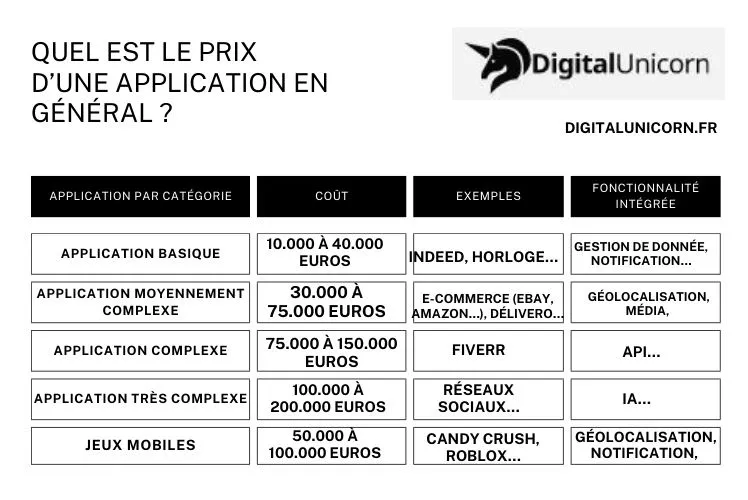
These ranges cover most ambitious mobile applications, from mobile web to native. For highly visual experiences, Android or iOS applications with 3D or augmented reality, plan to dedicate resources to performance optimization and testing on Android smartphones, iPhones, and iPads so that your application remains among the best apps available for download in app stores.
The cost of a mobile app depends on a few key decisions. The scope, technical choices, integrations, quality, publication, and maintenance make up the bulk of the bill. When these elements are clarified from the outset, the budget becomes clear and trade-offs are easier to make.
The right calculation links every dollar invested to actual usage. We measure adoption, verify conversion, track retention, and manage customer value over time. This framework allows us to move quickly, adjust what matters, and fund what really drives performance.
To learn more about each area, continue with What factors influence the price of a custom mobile app. Compare approaches with Website, PWA, or native app: which to choose based on your needs. Align your budget with your growth strategy with Top 5 reasons to develop a mobile app in 2025.